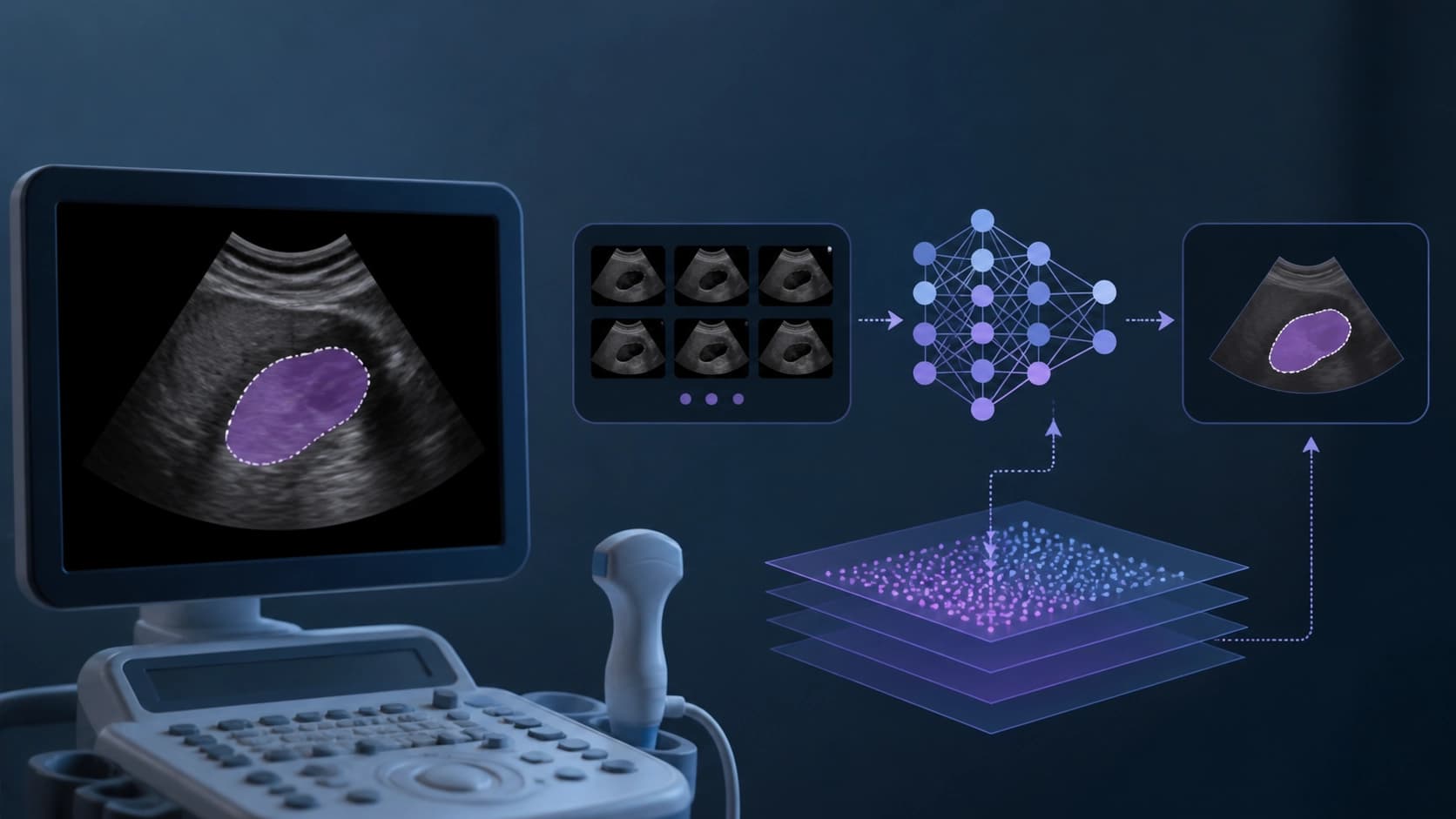
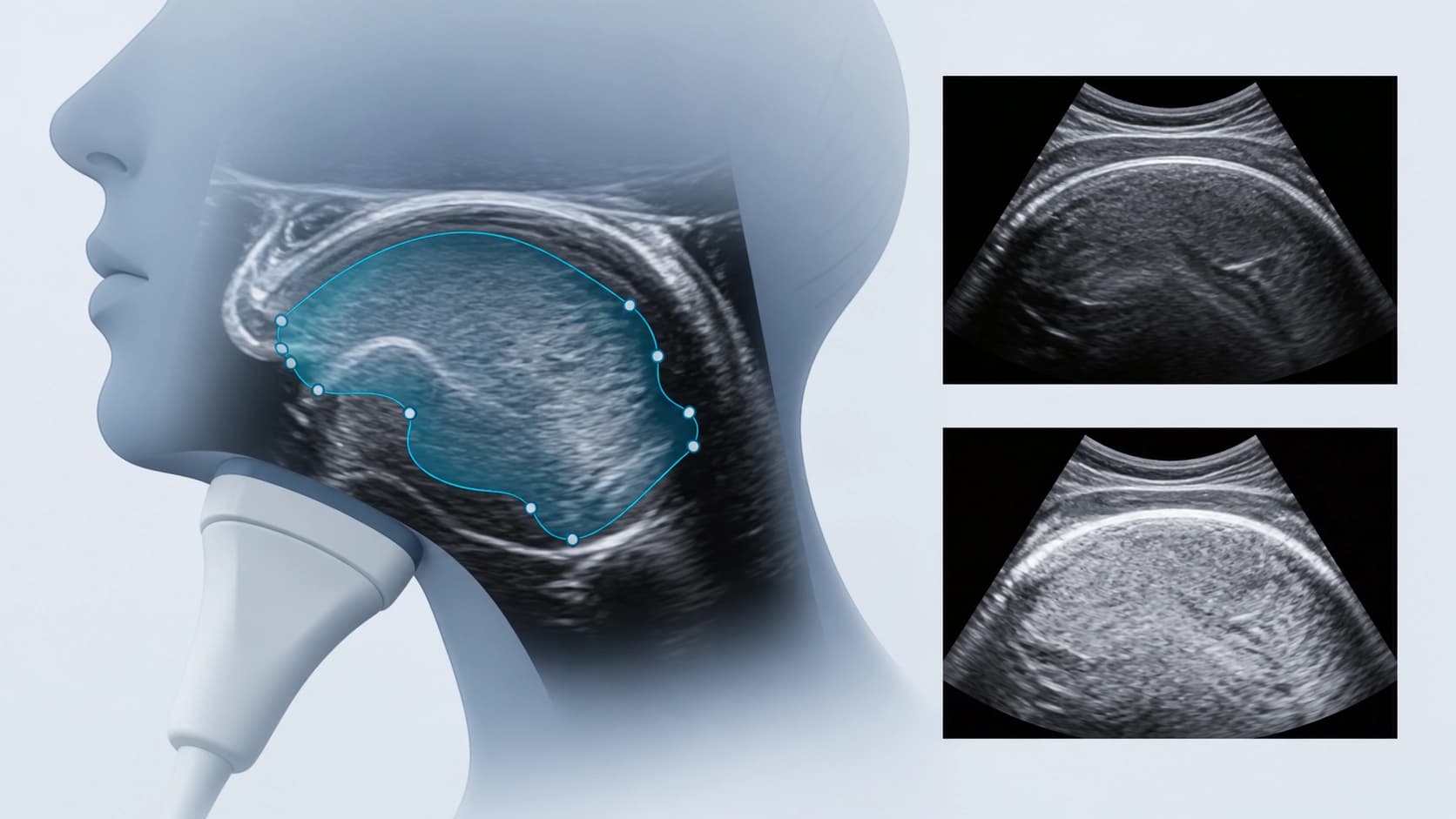
Language segmentation in ultrasound images is needed for analyzing articulation and diagnosing speech disorders, but collecting and annotating data is difficult: experts are required, and the images themselves vary greatly from one machine to another. When annotated data is scarce, standard neural network training fails: the model memorizes the specifics of a particular source and fails to generalize to new conditions.
Why this is challenging
The problem is not just the small number of annotations. Ultrasound tongue data is collected with different transducers, different settings, and from different people, so the image distribution in each new dataset is unique. This is called domain shift. If you train a model on one dataset and apply it to another, segmentation quality drops sharply. Classic adaptation methods require access to labeled data from the source domain, but in real-world tasks, you often only have a pretrained model and unlabeled images from the new domain.
The idea: source-free adaptation
The authors of a recent study propose a framework that adapts a model to a new domain with no labeled data at all and no access to the source images. They start with a lightweight backbone, UltraUNet, pretrained on just five labeled images. This is deliberately a weak starting point — it mimics a situation where the model is undertrained due to data scarcity. Then adaptation to the target domain follows, where there are no labeled examples whatsoever.
Pseudo-labels with filtering
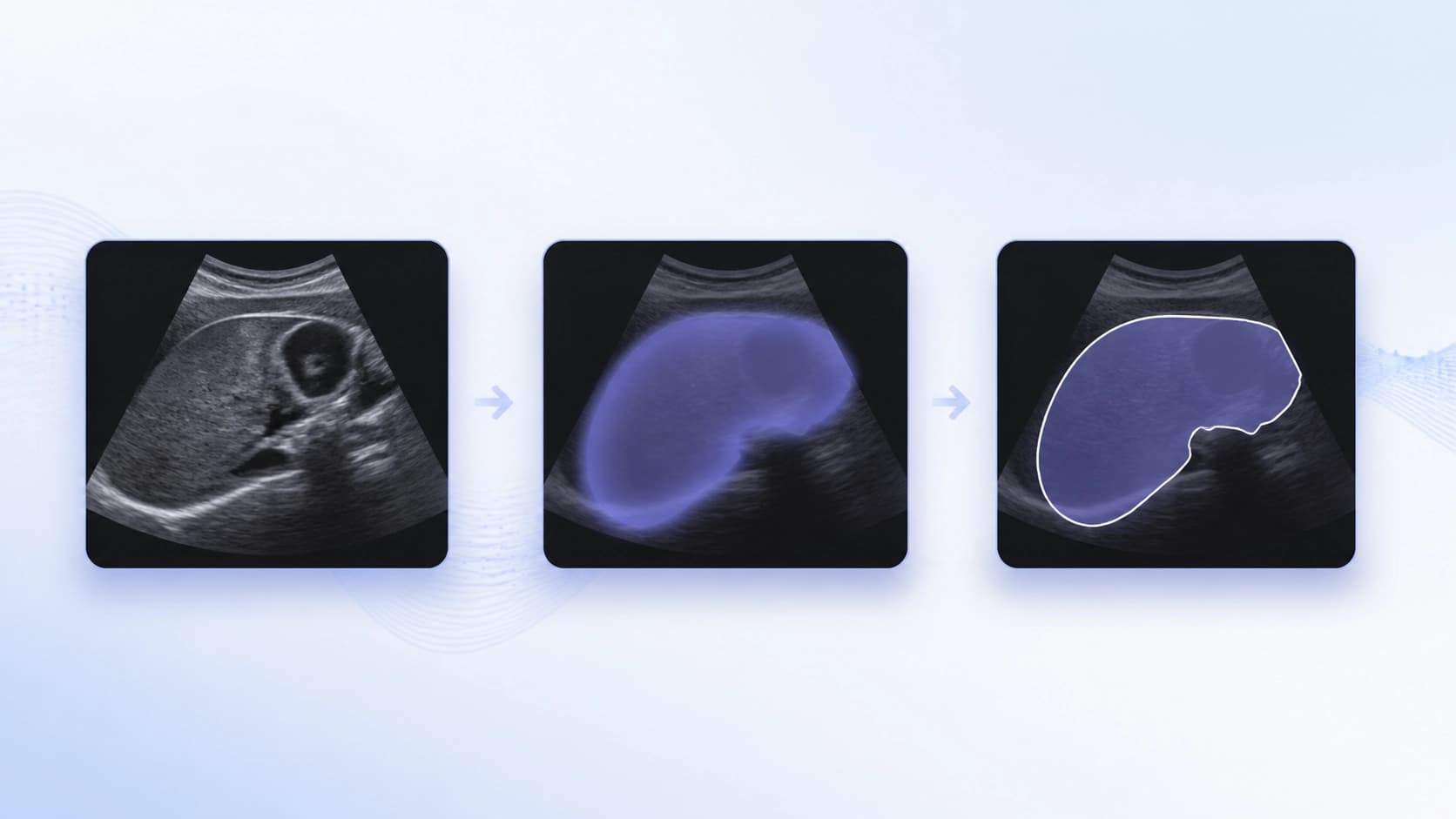
First, the model makes predictions on target images. These rough masks are called pseudo-labels. But not all of them can be trusted: some contours will be inaccurate or outright wrong. Therefore, the framework uses a dedicated contour quality control module that filters out unreliable masks. The remaining clean pseudo-labels go into training. The process repeats iteratively — with each cycle, label quality improves, and the model adapts better to the target domain.
Synthetic data in the target style
Additionally, a segmentation-guided conditional GAN generates synthetic image-mask pairs in the target domain style. This is similar to augmentation, but the data is created not by random transformations, but specifically to match the style of the new domain. The student model is trained on a mixture of three sources: clean pseudo-labeled target images, noisy pseudo-labels with consistency regularization, and generated synthetic samples. This mix makes the model robust to errors and helps it avoid overfitting to noise.
Results
The method was evaluated on 12 source-target pairs built from eight ultrasound tongue datasets. In all experiments, the proposed framework outperformed baseline approaches, including standard supervised training on limited data. Both segmentation overlap and contour accuracy improved. The authors conclude that pseudo-label refinement and synthetic augmentation in the target domain style are key components that enable adaptation with almost no annotation.
This approach opens a practical path: you only need to train a model once on a small dataset, and then gradually adapt it to new conditions — a new transducer, a different transducer placement, or a different patient population — without labor-intensive manual annotation.