
Two-signal checkpoint testing: uncovering hidden abliteration and its weak spots
The author proposes a threshold-free audit of open-weight models based on a pair of complementary signals within the artifact. In tests on 273 checkpoints, the method achieves an AUROC of 0.95, but remains a triage tool rather than a defense against deliberate circumvention.

Why check checkpoints, not just their answers
When preparing an open model for deployment, it's important to understand who modified it and how. Beyond standard fine-tuning, there is abliteration — a technique that selectively removes the refusal signal for harmful requests from activations. The model remains outwardly similar to the original, but in fact operates without an internal "stop." Detecting such tampering through generations is difficult: runtime guards run test prompts and evaluate responses, not the artifact itself. If a harmful scenario doesn't make it into the test set, no one will notice the modification. That's why an honest audit of weights should be performed before inference, not during it.
Two audit axes: activation gap and weight trace
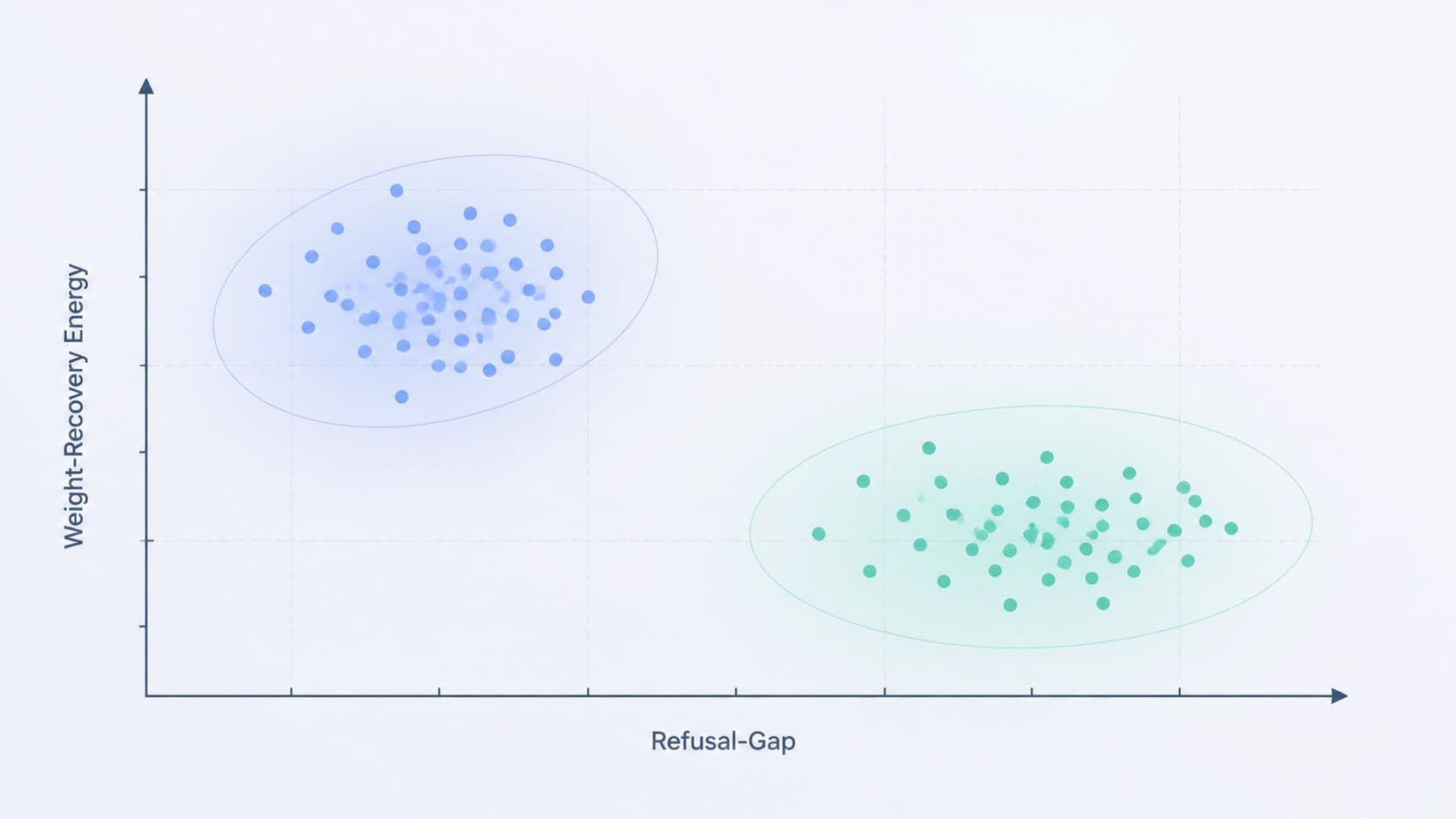
Research presented in the field of cryptography and security describes a cheap two-signal audit that requires no threshold tuning and does not rely on external behavioral tests. A suspicious checkpoint is compared against an attested reference along two axes:
- Reference-anchored activation refusal-gap — the gap between refusal-related activations in the candidate and in the reference. If abliteration has erased the refusal pattern, the gap behaves differently than in honest fine-tuning.
- Weight-recovery energy — the energy of weight recovery: how strong a parameter change is needed to return the candidate to the base version. This signal catches even those interventions that barely show up in activations.
The signals are negatively correlated, so their combined z-statistic turns out to be more informative than each axis alone. The first axis is responsible for specificity: it shows whether the refusal mechanism itself is affected. The second is responsible for recall: it prevents hiding a modification in subtle weight edits.
How reliable is the method in practice
The audit was tested on a registry of 273 checkpoints covering different open architectures. Within the sample, the combined z-signal separated 57 public abliterations from 37 ordinary cases of fine-tuning, merging, and instruction tuning almost without error: AUROC 0.95. Individually, the same signals give noticeably worse results — 0.84 and 0.90. More interestingly, the threshold calibrated using Youden's index transfers to new, previously unseen families. There, balanced accuracy was 0.89 with a false positive rate of 0.11. Of the 57 abliterations, the method missed only 4 — by the standards of a primary filter, that's a good result.
Weak spots: when both axes are fooled
No two-signal audit covers all attack scenarios. The authors honestly list two types of failure.
The first is a forged reference. If an attacker controls the reference point, they can pick a baseline so that the base-to-candidate difference is zero by construction. Then there's no need to even train the model: both axes will show normal behavior.
The second is a white-box attack on the threshold. If the weight owner has full access to the model, they can deliberately fine-tune a checkpoint so that it falls outside the decision boundary while remaining unsafe from the guards' perspective and preserving coherence.
That's why the authors call the approach an effective triage, not protection against tampering. It allows quickly filtering out clearly clean and clearly suspicious checkpoints, but it cannot serve as the sole security barrier.

Conclusion: a tool for the first filter
The two-signal check is good because it requires only a trusted reference and two cheap measurements, and the result is easy to calibrate for a specific registry. The main limitations are dependence on an attested baseline and vulnerability to a targeted white-box attack. In addition, the statistics have so far been collected on a single registry, so accuracy may change on significantly different architectures. Still, for the open-weight ecosystem, this is a practical step: previously one had to choose between superficial generation tests and full reverse engineering, and now there is an intermediate option that can be used as a first filter.
Frequently asked questions
Related materials
All materials
Canonical Polynomial Invariants for Diagnosing RL Simulator Failures: Where Are They Actually Useful?
The study examines whether incorporating physical laws into learnable dynamics models is justified: invariants extracted from trajectories and reduced to canonical form using Gröbner bases yield modest forecasting gains, but prove powerful for diagnostics, enabling the localization of violated constraints and identification of specific erroneous parameters.
10 November 2026
AURA-Eval: How to Check Whether an LLM Agent Recognized a Risk and Changed Its Next Step
The framework evaluates LLM agents’ behavior not by their final verdict, but by how they respond to risk at key decision points: tool-call trajectories are interrupted, after which the model must continue reasoning and acting, while a panel of LLM judges assesses risk detection, the nature of the step, and its safety. Across 1,249 tasks drawn from 157 R-Judge trajectories, unsafe actions become more frequent among 20 models when no safe path is available, and removing oversight before execution turns 52.3% of initially safe cases into unsafe ones.
10 November 2026
Chern–Simons Reservoir Memory: Autonomous Connectivity Dynamics and Density Transport
The article explores how a reservoir preserves the history of input signals both in its density distribution and in its geometric degrees of freedom. A comparison of four mechanisms shows that current creates a separate connected component that alters the subsequent density response, while accounting for all measured features yields a small improvement in decoding pulse order.
10 November 2026