
Twitch streams and clips are used in training Amazon's AI: enable the ban in settings
Twitch has started giving users the ability to disable the use of their videos and posts for training AI models of the parent company. The new option has raised questions among streamers: previously, their content could be included in the training dataset automatically, and opting out is only possible manually.

Twitch has given streamers the ability to prevent Amazon from using their clips and broadcasts to train neural networks. The new option appeared in account settings, but it wasn't discovered right away — many content creators only learned about it after digging into the changes. The situation exposed a long-standing practice the platform preferred not to address directly.
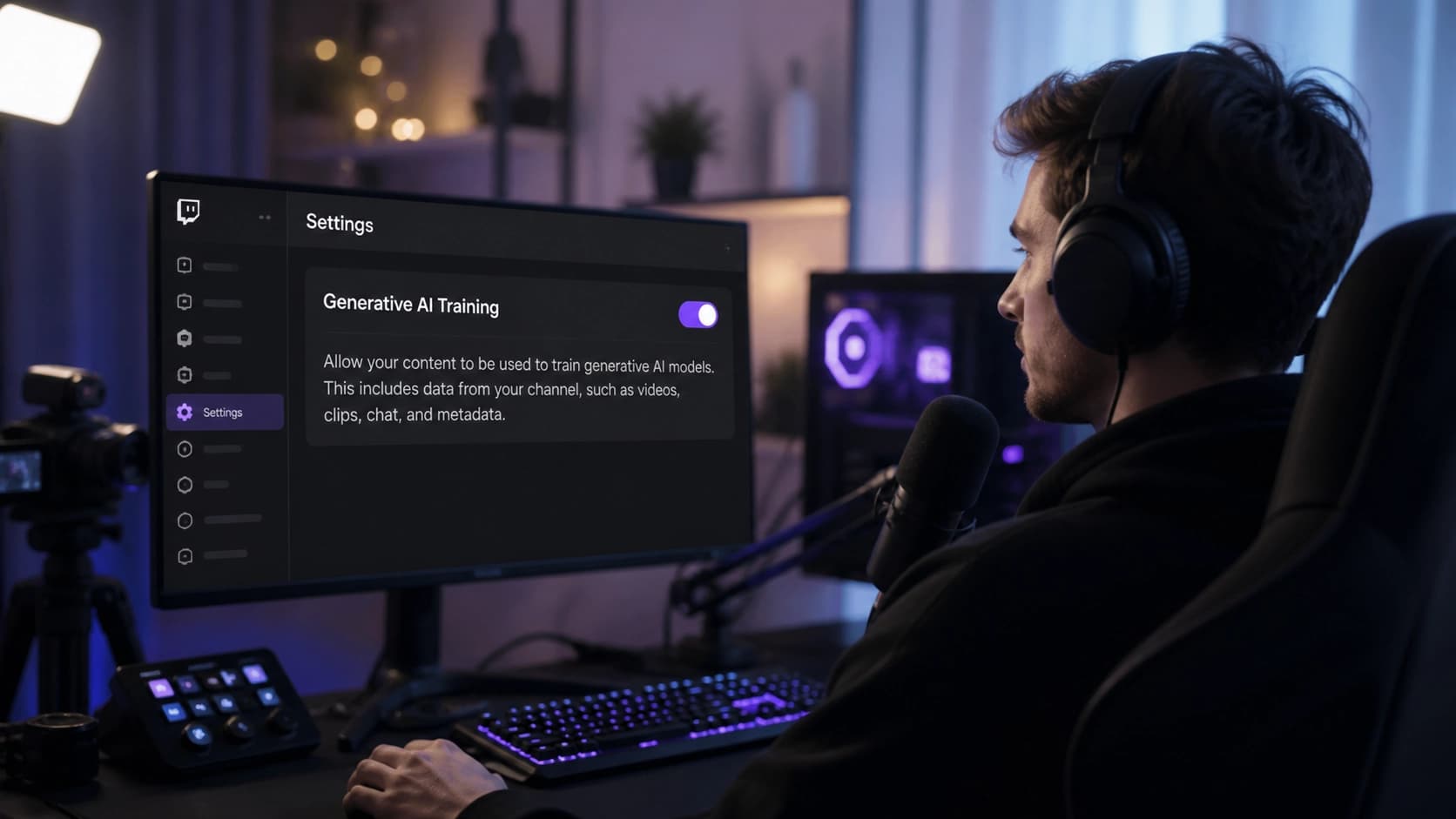
How to disable content sharing for AI training
To prevent your streams and clips from being used to train Amazon's models, go to your profile settings. In the app or on the Twitch website, open your avatar, then navigate to Settings, select the Security and Privacy section, and find the Generative AI Training option. All you need to do is toggle it off — and your content will no longer be used for these purposes.
It's important to understand that disabling this doesn't affect other platform features. As stated in the explanation next to the toggle, Twitch and Amazon may still use creators' materials for other purposes described in the Privacy Notice. These include suggestions for sponsored integrations, personalized recommendations for viewers, and automatic chat filtering. In other words, the option specifically limits generative AI models only, not all analysis of user data.
Why this sparked controversy
The appearance of this setting is an acknowledgment that streamers' content was previously used without explicit consent. More than 16,000 creators voiced their objection: they don't want their work to become training material for AI by default. The backlash intensified after a live stream where Twitch's community chief, Mary Kish, explained the changes. She admitted she expected a negative reaction — and she wasn't wrong.
Twitch's head of product, Mike Minton, responded by saying the opt-out setting was necessary: otherwise, in his words, "nobody would participate" in the process. He added that this practice isn't unique to Twitch. Minton suggested that almost any publicly available content is used for training models in one way or another — with or without creators' permission — and that much of it happens beyond the platform's control.

Questions that remain unanswered
Streamers want to know exactly when Twitch started sharing data with Amazon. Previously, the user agreement in effect since March 2024 stipulated the right to use, modify, and distribute content, as well as create derivative works based on it. However, training generative AI models was not explicitly mentioned there. Now creators doubt they can fully control how their materials are used, and they're asking who else has access to them.
It's unclear whether Amazon is the only company receiving Twitch data or whether third-party partners are involved. There's also no information about whether authorship is taken into account in such training or whether streamers can expect compensation. So far, the platform hasn't provided clear answers.
The bigger picture: everyone is short on data
The Twitch story is just one example of the growing competition for high-quality AI data. Major companies are scouting for new content sources everywhere. OpenAI, for instance, has struck deals with publishers, including Condé Nast. Meta has used Facebook and Instagram users' posts and photos to train its models, as well as employee correspondence and images from smart glasses. Similar cases have been documented with Google and YouTube.
High-quality data has become a strategic resource on par with chips, memory, and electricity. Leading AI developers are facing a critical shortage, which is why they turn to public content, sometimes without even notifying creators. The Twitch case shows that users are increasingly demanding transparency and a say in this process — and platforms are being forced to respond, albeit belatedly.

Frequently asked questions
Related materials
All materials
Toollery: Choose tools for LLM agents from tens of thousands of options without fine-tuning
Toollery builds a search index from descriptions of skills and tools, then passes the model only a limited set of candidates for each query. In experiments with libraries containing tens of thousands of functions, the approach helps maintain selection quality at a fixed top-K, although the overall effect depends on the workload profile and the provider’s caching.
11 November 2026
WILSON: combining magnifications and patient slides for pathomorphological analysis and report generation
The preprint introduces WILSON, a vision-language model that encodes images of whole slides and series of slides from a single patient at different magnifications, rather than just a single “best” slide. Without task-specific fine-tuning, it outperforms specialized and larger slide models on a range of metrics while requiring substantially less compute, and its diagnostic descriptions received higher ratings from pathologists.
11 November 2026
Canonical Polynomial Invariants for Diagnosing RL Simulator Failures: Where Are They Actually Useful?
The study examines whether incorporating physical laws into learnable dynamics models is justified: invariants extracted from trajectories and reduced to canonical form using Gröbner bases yield modest forecasting gains, but prove powerful for diagnostics, enabling the localization of violated constraints and identification of specific erroneous parameters.
10 November 2026