
$12.1 billion on Intel: why Masayoshi Son bet almost his entire portfolio on the chipmaker's revival
Intel's stake in SoftBank's disclosed US portfolio was worth about $12.1 billion at the end of June, making up roughly two-thirds of it. With such concentration, Son is making a risky bet that Intel can restructure in time and capture its share of the AI boom; the recent $20 billion inflow into the company also supports this plan.
Masayoshi Son is not one to hide behind small bets. His portfolio includes both giants ready for growth and companies on the verge of a turnaround. The new target is Intel, in which SoftBank, according to documents filed with the US regulator, has invested around $12.1 billion. For a fund that usually counts its money across dozens of directions, such concentration is a rare exception. This is not just a stock purchase, but a statement that the former leader of the semiconductor industry may still return to the game for leadership in the era of artificial intelligence.
Intel at the center of the portfolio: numbers and logic
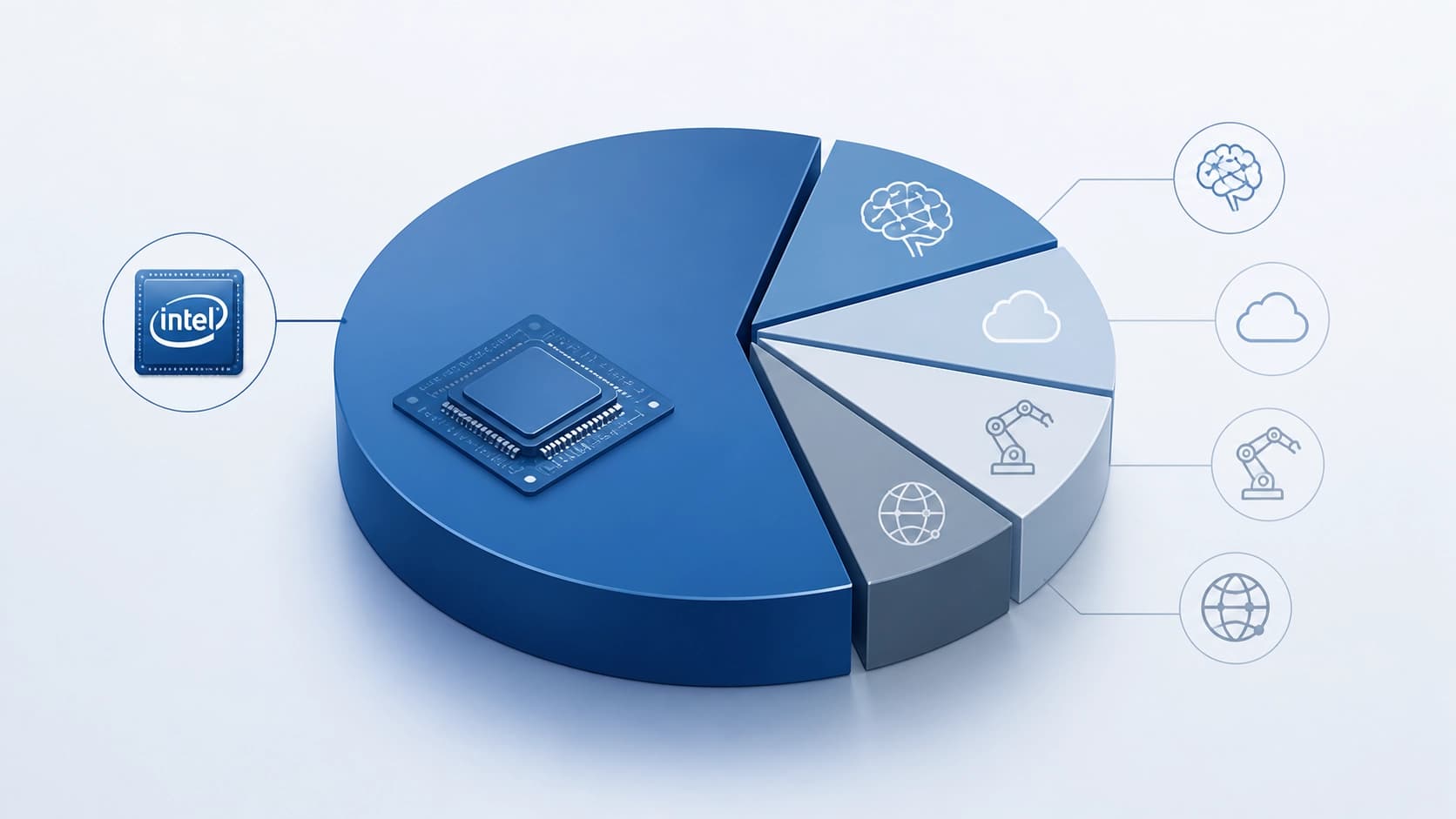
The disclosed data shows: as of the end of June 2026, SoftBank held 86,956,522 Intel shares worth about $12.14 billion. That is roughly 66% of the fund's entire disclosed US equity portfolio, which was valued at $18 billion. In other words, almost everything SoftBank publicly holds in the US is now tied to the success of a single chipmaker.
Such concentration is not a random move. Son has been consistently shifting from classic venture investments in startups toward AI infrastructure and computing power. Semiconductors are the foundation of that infrastructure, and Intel, despite all its difficulties, remains one of the few manufacturers capable of servicing and designing chips on a global scale. So buying Intel stock looks like a logical continuation of a strategy in which AI has already become the main compass.
Why this particular size
Holding two-thirds of US assets in a single issuer means giving up diversification for the sake of one strong thesis. Son is clearly willing to take on risk because the potential reward is too great. If Intel manages to restructure its manufacturing business and carve out a significant place in the AI supply chain, the value of this position could multiply. Son himself is known for big bets: he believed in Alibaba early, backed AI startups, and kept increasing stakes in companies operating at the intersection of computing and artificial intelligence.
But conviction comes at a price. Intel's market dynamics will now directly determine the overall valuation of SoftBank's disclosed US assets. And that creates nervousness: any problems at the chipmaker immediately show up on the fund's balance sheet.
Intel: a bet on a difficult comeback
Intel has long ceased to be the monopoly player that set the pace for the entire industry. The fight for new manufacturing technologies is an uphill battle: the company lags competitors in advanced lithography and fails to keep up with demand for AI accelerators. In an attempt to turn things around, Intel launched its own turnaround program, strengthening its contract manufacturing business and trying to convince investors that it can catch up with the leaders.
A key signal in favor of Intel having a chance is the recent raising of $20 billion. That amount of capital gives the company room to rebuild fabs and fund technology development. For SoftBank, this is a kind of confirmation that Intel has not been left without market support, which slightly reduces the risk of the private investment.
Still, pressure on the stock persists. Right after SoftBank disclosed its position, Intel's share price moved down. That is a reminder: even if a strategy seems well thought out and long-term, short-term market fluctuations never go away.
AI as the main driver of the idea
The key to understanding why Son went into Intel with nearly his entire portfolio lies in his vision of the future. He has repeatedly stated that artificial intelligence will transform every industry. But AI requires not just algorithms — it also demands enormous computing resources. Data centers, networks, specialized processors — all of this becomes critically important. In recent years, SoftBank has been ramping up investments in infrastructure projects, from data storage to power plants for AI systems. The Intel purchase fits into that same picture.
Against this backdrop, Intel is attractive from two angles at once. First, the company retains serious expertise in processor design. Second, it has a unique opportunity to become a major contract manufacturer for other companies that design their own chips but do not have their own fabs. If the AI market keeps growing at its current pace, Intel could end up among the biggest beneficiaries: demand for advanced semiconductors will only intensify.
Why others are not convinced yet
Despite the loud statements, most investors assess Intel's prospects with caution. The company will need more than one quarter to show real results from its business overhaul. The question is not whether Intel wants to take part in the AI race, but whether it can do so faster and more efficiently than its competitors. As long as rivals outpace Intel on key chip characteristics, any positive news will be met with skepticism by the market.
Son probably understands this skepticism. His bet reflects a different assessment: he is looking at a horizon of several years, not the next reporting period. What matters to him is that Intel manages to restructure before demand for AI chips peaks. If that happens, the current low valuation of the stock will look unjustified. If not, two-thirds of the portfolio will become a serious burden.
The bottom line: calculated risk or gambling?
Masayoshi Son's decision to back Intel with nearly his entire portfolio looks like a paradox. On the one hand, it strongly resembles an emotional bet on the return of a legendary company. On the other, there is clear logic behind it: AI infrastructure needs new capacity, and Intel has a chance to become one of its key suppliers.
SoftBank has already had successful experience with bold investments in companies that seemed too weak at the time. But every big bet cuts both ways. Intel's success depends on whether it can finally deliver on its ambitious plans in chip manufacturing and design. Son is willing to wait and take on the main risks. After all, that is how he earned his reputation as an investor who is not afraid to go all in when he believes in a technological breakthrough. Now the ball is in Intel's court: to justify that vote of confidence or turn SoftBank's portfolio into a monument to unfulfilled hopes.
Frequently asked questions
Related materials
All materials
WILSON: combining magnifications and patient slides for pathomorphological analysis and report generation
The preprint introduces WILSON, a vision-language model that encodes images of whole slides and series of slides from a single patient at different magnifications, rather than just a single “best” slide. Without task-specific fine-tuning, it outperforms specialized and larger slide models on a range of metrics while requiring substantially less compute, and its diagnostic descriptions received higher ratings from pathologists.
11 November 2026
Canonical Polynomial Invariants for Diagnosing RL Simulator Failures: Where Are They Actually Useful?
The study examines whether incorporating physical laws into learnable dynamics models is justified: invariants extracted from trajectories and reduced to canonical form using Gröbner bases yield modest forecasting gains, but prove powerful for diagnostics, enabling the localization of violated constraints and identification of specific erroneous parameters.
10 November 2026
AURA-Eval: How to Check Whether an LLM Agent Recognized a Risk and Changed Its Next Step
The framework evaluates LLM agents’ behavior not by their final verdict, but by how they respond to risk at key decision points: tool-call trajectories are interrupted, after which the model must continue reasoning and acting, while a panel of LLM judges assesses risk detection, the nature of the step, and its safety. Across 1,249 tasks drawn from 157 R-Judge trajectories, unsafe actions become more frequent among 20 models when no safe path is available, and removing oversight before execution turns 52.3% of initially safe cases into unsafe ones.
10 November 2026