
SGHA: fully autonomous scientific gap search on a local LLM without external APIs
A new system transforms a large set of articles into a structured evidence graph and, using an open 9-billion-parameter model, identifies unresolved research questions. The approach increases process transparency, reduces hallucination risks, and does not require sending data to external services.

Introduction: Why AI Scientists Get Stuck at the Start
Modern language models have become quite good at handling the routine of scientific work: they generate hypotheses, write code for experiments, and even draft paper manuscripts. However, when trying to automate the entire research cycle, an unexpected bottleneck emerges — the early stage where the research problem itself needs to be formulated.
Most existing AI scientists turn to commercial APIs of proprietary models at this step. This is like a black box: suggestions emerge from the model's parametric knowledge and a literature search that is pre-tuned to the generated ideas. It's practically impossible to verify which facts a conclusion is based on. Add the risk of hallucinations and systematic biases of a particular model — and you get a starting point for research that may be not just random, but unjustified.
Privacy is another pain point. Scientists aren't always willing to send their work to external APIs, especially when it comes to unpatented ideas or sensitive topics. So it's no surprise that local approaches that stay within the research infrastructure are attracting more and more attention.
This is where the SGHA system, developed by Sarvesh Gharat and Junpei Komiyama, enters the scene. Their preprint appeared on the archive on August 18, 2026. The authors propose a fully autonomous pipeline for scientific gap discovery that runs on a local open model without a single call to external APIs. But let's take a closer look at how it works.
How SGHA Works: From Corpus to Research Problems
Unlike typical agents that simply "think" in free form, SGHA bets on an explicit structure of the scientific corpus. The first stage is turning a body of papers into evidence-linked article objects and a typed evidence graph. Put simply, each publication is broken down into entities and relations: what claims it makes, which works it builds on, which experiments support its conclusions.
The system then looks for unresolved structural patterns in this graph — potential gaps. These aren't just textual matches, but "holes" verifiable against factual material: for example, two research areas are clearly related, but no one has tried to combine them. Importantly, each candidate gap must pass a soundness check before becoming a full-fledged problem formulation.
From Patterns to Problem Families
As output, SGHA creates families of research problems, each specifying:
- assumptions;
- goals;
- success criteria;
- remaining ambiguities.
This approach lets a researcher see not just an idea, but its rationale and boundaries of applicability. At the same time, all reasoning is constrained by evidence from the corpus, which sharply reduces the likelihood of hallucinations.

Fully Local: Only an Open 9B-Parameter Model
The key feature of SGHA is full autonomy. All components related to language processing and reasoning run on a locally deployed open model with 9 billion parameters. No proprietary front-end model APIs, no data transfer outside. Even a long research process won't require a single external request.
This isn't just a matter of convenience. For labs working with industrial orders or medical data, this approach removes an entire class of data governance and confidentiality issues. Moreover, an open 9B model is a fairly modest size by modern standards, making the system feasible to run on a single powerful workstation.

Evaluation: Comparison with AI Scientist-v2
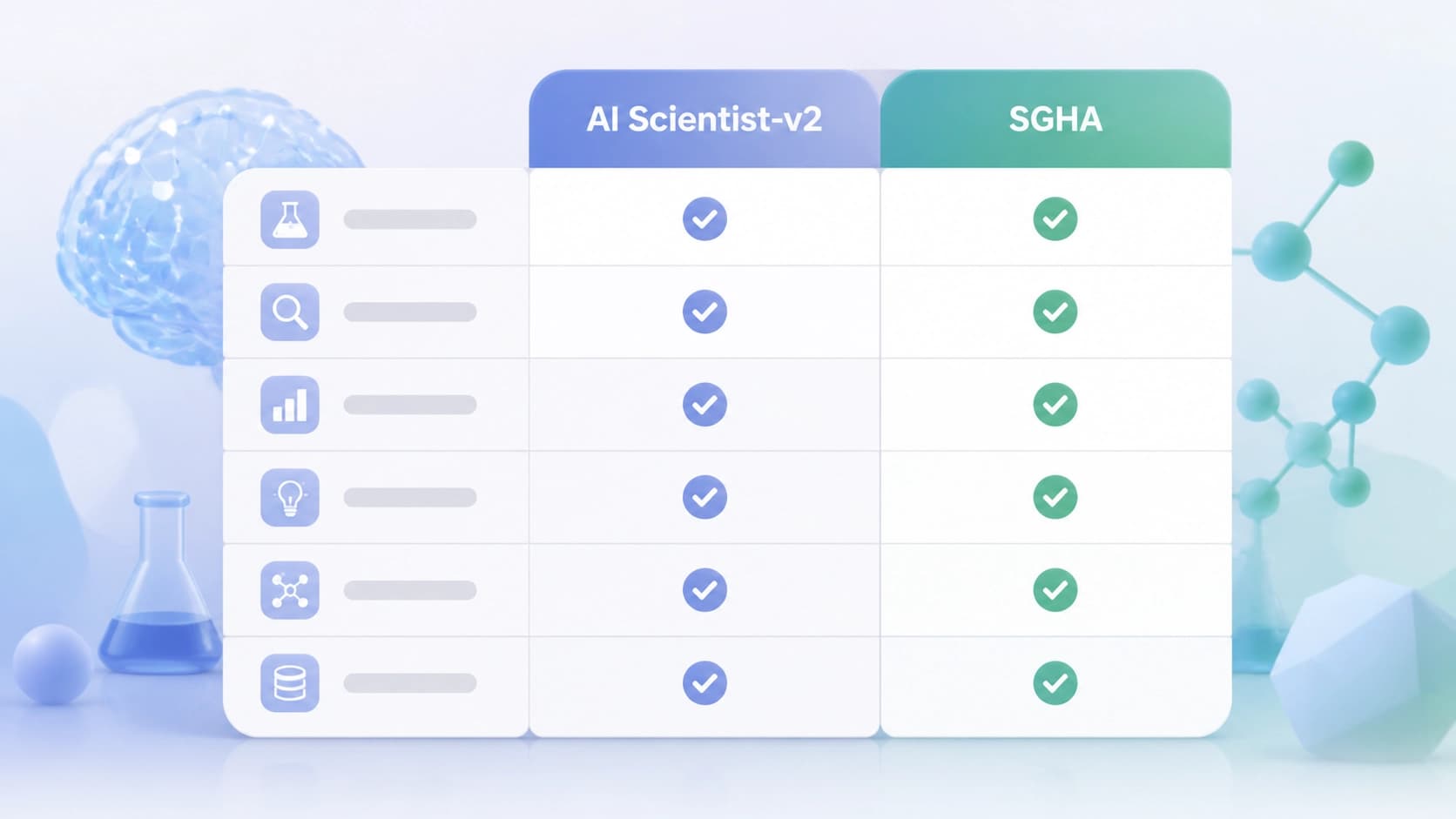
The authors tested the system across five machine learning domains, comparing it with the idea formulation module from the AI Scientist-v2 project. The results show that the approach with explicit corpus structure and evidence verification yields at least as promising and verifiable problem formulations as using much more powerful front-end models. SGHA doesn't just generate topic names — it lets you trace which papers and relations led to a particular problem statement.
This solves the "black box" problem and makes the process auditable. And given full locality, such an agent can be easily embedded into scientific workflows without worrying about security policies.
Conclusions and Outlook
SGHA is a compelling example that formulating scientific problems doesn't require hooking up giant cloud models. Corpus structuring, an evidence graph, and a local 9B model can deliver quality sufficient for promising and verifiable research problems. Of course, much work lies ahead: the authors promise to release the code and artifacts, which will allow other groups to reproduce the results and adapt the system to their own domains.
If the trend holds, in the coming years we'll see a whole class of AI scientists that don't depend on external APIs and are fully transparent to scrutiny. That means the automation of science will become not only more efficient, but also safer.
Frequently asked questions
Related materials
All materials
OpenCollab: programmable agent coordination, controlled execution environment, and policy compliance metric
The framework brings together the specification of agent interaction structures, a shared environment for experiments, and detailed event tracing, while the newly introduced Adherence metric reflects how closely actual execution follows the declared schema. In benchmarks, the Duo configuration achieves a new state of the art, while the single-agent variant uses the fewest tokens.
11 November 2026
Toollery: Choose tools for LLM agents from tens of thousands of options without fine-tuning
Toollery builds a search index from descriptions of skills and tools, then passes the model only a limited set of candidates for each query. In experiments with libraries containing tens of thousands of functions, the approach helps maintain selection quality at a fixed top-K, although the overall effect depends on the workload profile and the provider’s caching.
11 November 2026
WILSON: combining magnifications and patient slides for pathomorphological analysis and report generation
The preprint introduces WILSON, a vision-language model that encodes images of whole slides and series of slides from a single patient at different magnifications, rather than just a single “best” slide. Without task-specific fine-tuning, it outperforms specialized and larger slide models on a range of metrics while requiring substantially less compute, and its diagnostic descriptions received higher ratings from pathologists.
11 November 2026