
Search GPT or Google: comparison of features and use cases
Let's break down how chat search differs from OpenAI and classic Google results: interface, depth of answers, data freshness, and personalization. We'll point out which service is more convenient in each situation.
Introduction
Web search is gradually becoming more than just a list of links. With the rise of large language models, users increasingly want a ready-made answer rather than a list of pages to explore on their own. The most notable example of this approach is OpenAI's experimental Search GPT. But can it compete with the familiar Google? Let's compare them across key features and use cases.
What Search GPT can do
Search GPT is a prototype search engine built on OpenAI's language models. Its main feature is a conversational interface. You interact with the system as if talking to a companion: you ask questions in natural language, get answers with sources, and can immediately clarify details. The system accesses web information in real time, gathers data from various sites, and formulates a comprehensive answer in a single message.
An important nuance: as of mid-2024, the project remains a temporary prototype with limited access — roughly ten thousand users on a waitlist. OpenAI views it more as an experiment, planning to integrate the best features into ChatGPT rather than maintain a separate product.

Why Google remains the giant
Google has dominated web search for over two decades. Its strength lies in a massive index of web pages and refined ranking algorithms that have outlasted many generations of search engines. The company is rolling out AI features, such as generative answers from Google Bard, but the core model remains the same: you get a list of links and decide where to go yourself. It's familiar, predictable, and convenient for quick, surface-level queries.
Comparison across key parameters
Interface and communication style
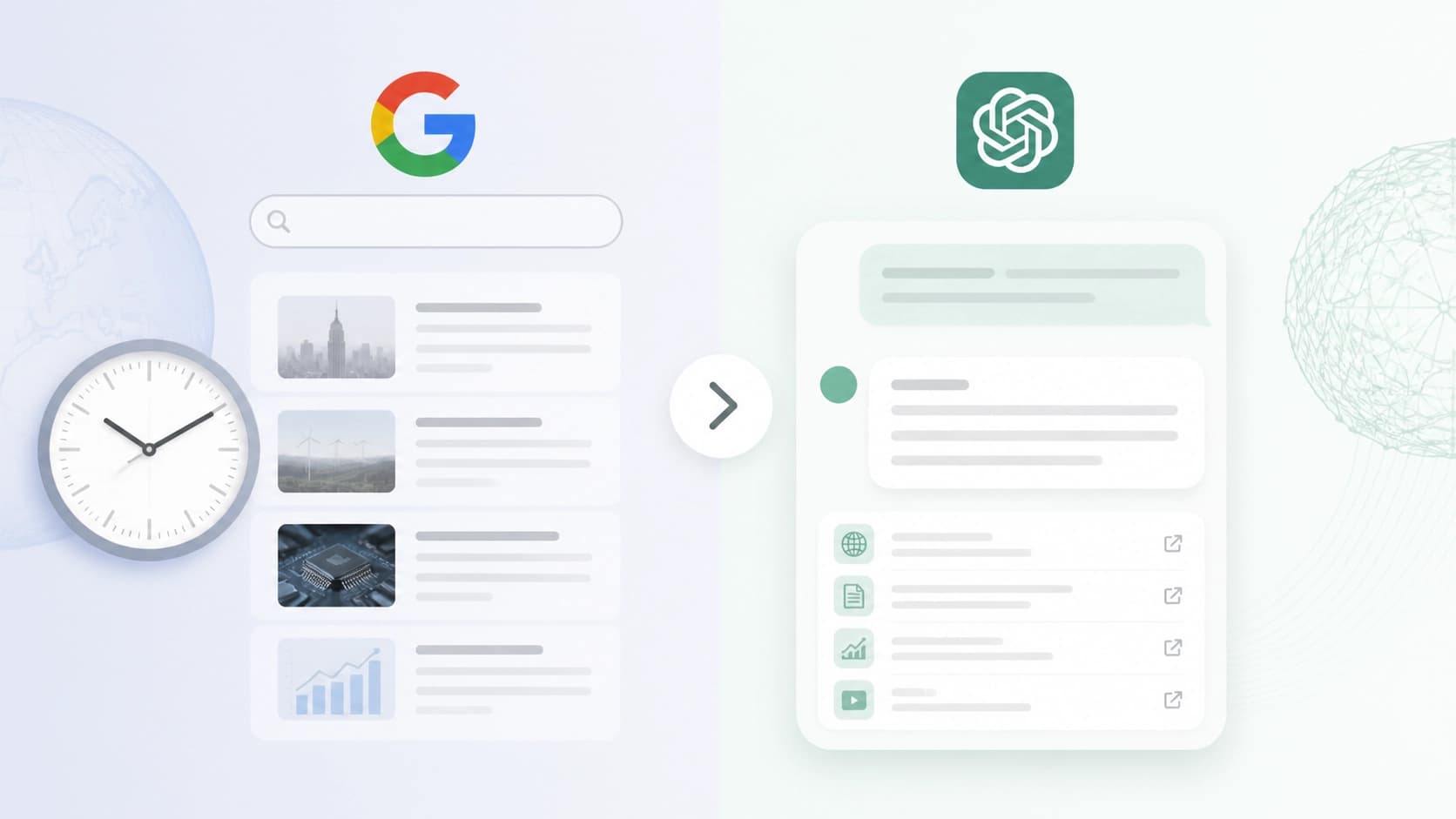
Search GPT uses a chat format: you type a question like in a messenger, and the system maintains a dialogue, taking previous messages into account. Google uses a traditional search bar but also offers voice input and image search.
Information synthesis
Search GPT excels at summarization: it pulls data from multiple sources and delivers a coherent answer with cited links. Google, on the other hand, shows a list of pages, and to get the full picture, users have to open several sites and piece the information together themselves.
Relevance and fresh data
Here, Google has the advantage: news, trends, and other constantly updated sections allow it to reflect events almost in real time. Search GPT's model knowledge isn't continuously updated, so it may handle the latest events less effectively or not know about them at all.
Visual search
Google offers advanced image search, including reverse image lookup. Search GPT in its current version is limited in processing and generating images, so visual queries are beyond its reach for now.
Personalization
Google personalizes results for each user: it takes into account history, location, interests, and previous clicks. Search GPT gives more universal answers by default but can adapt to the conversation context, so within a single dialogue, results may shift based on your clarifications.
When to choose Search GPT and when to choose Google
The choice comes down to the use case. Search GPT is convenient for deep, conversational queries when you need to explain a complex concept, compare several options, or consolidate scattered data into a single answer. It's a tool for those who prefer dialogue over sifting through links.
Google remains the best choice for quick factual checks, searching a specific site, tracking breaking news, and visual search. Its familiar interface and massive index make it a reliable workhorse.
Conclusion
There's no perfect search engine — what matters is understanding what you need at any given moment. If you want a ready-made synthesized answer and the ability to have a clarifying dialogue, Search GPT looks very appealing. If speed, relevance, and familiar results matter more, Google is unmatched. Most likely, the future lies in a hybrid approach, where conversational AI is integrated into classic search engines and complements them rather than replacing them.
Frequently asked questions
Related materials
All materials
Diversity in the Input, Not in the Reasoning: Comparing Test-Time Augmentation Methods for LLMs
The study compares sources of variation in LLM inference—query paraphrasing, spelling changes, and image transformations—at an equal number of calls. Across six benchmarks, preserving meaning yielded the greatest improvement in accuracy, while character-level noise and simultaneous perturbations of two modalities were less useful.
8 November 2026
Neptuna: Comparing ML Architectures for Compressible Multiphase Flows with Discontinuities
Introducing Neptuna, a large-scale benchmark with 3 TB of computations for bubble collapse and droplet breakup under shock waves, evaluating convolutional, spectral, transformer, and pretrained PDE models. The takeaway: there’s no universal leader, while composite loss functions and SoftAdapt help better preserve interfacial boundaries and reproduce the spectrum more accurately.
6 November 2026
From Individual Scores to Feasible Sets: Global Decoding Under DDI Constraints
The article compares exact global selection of a compatible medication set using mixed-integer linear programming with several schemes for locally resolving DDI conflicts under fixed FLAME scores on MIMIC-III. On the test set, the global approach delivers a small but consistent gain in Jaccard, which increases as constraints tighten and reaches +0.0064 over the strongest local baseline.
4 November 2026