
Running AI agents locally: Perplexity and NVIDIA bet on on-device data processing
Companies introduced Portable Computer — an environment where agents, tools, and code execution run on the user's own hardware, with data transferred to the cloud only after their explicit consent. Currently, the solution is designed for Linux with NVIDIA GPUs of at least 24 GB VRAM, including DGX Spark, while Windows support is promised for a later date.
What Perplexity and NVIDIA Announced
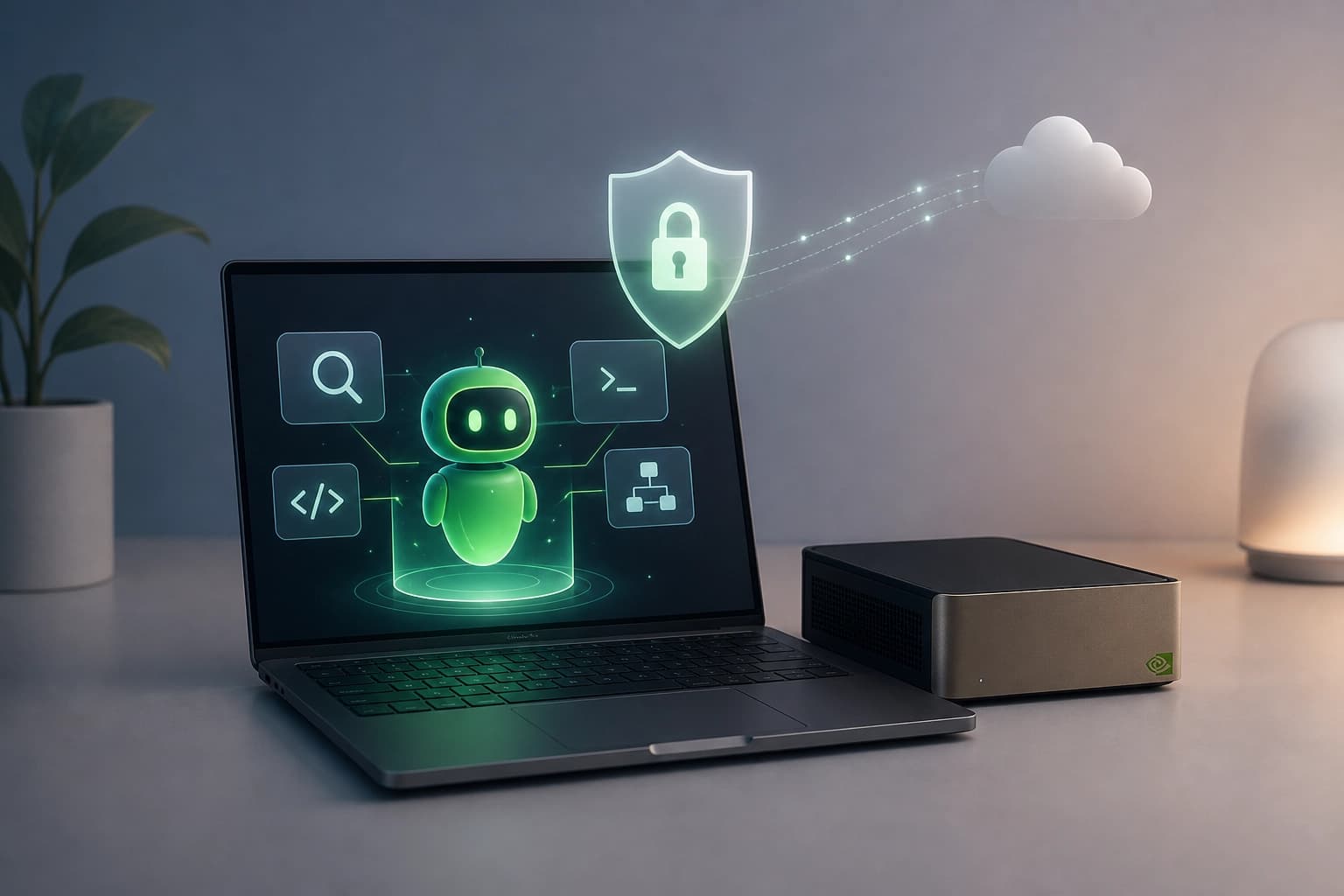
Perplexity and NVIDIA introduced Portable Computer. It is a local AI tool for running agents on the device.
- Portable Computer runs AI agents directly on devices.
- The tool gives greater control over data.
- It requires powerful NVIDIA hardware and Linux support.
- Portability allows working without relying on cloud services.
- A Windows version is expected.
The partnership reflects the trend toward local AI processing. Conclusion: Portable Computer is suitable for local work, but depends on hardware.
How Local Processing Protects Data
Local execution reduces the need to send data to the cloud. Information stays on the device if the task does not require cloud services.
- The device executes code and uses various tools.
- The application requests permission to upload to the cloud.
- The user chooses whether to upload data.
- The approach is relevant for personal and professional data.

Conclusion: local processing gives control over data, but does not eliminate the cloud.
Hardware and Platform Requirements
Portable Computer requires Linux. An NVIDIA GPU with at least 24GB VRAM is needed.
- This is the main limitation of the tool.
- The tool is suitable for professionals and users of high-end systems.
- Currently, Portable Computer runs on NVIDIA DGX Spark.
- Soon it will run on NVIDIA RTX GPU PCs.
- Windows support is expected.
Conclusion: advanced NVIDIA hardware is required to run it. The tool targets users with hardware for demanding models.
Models and Access Conditions
The system supports several models. The first release is available to Pro and Max subscribers on NVIDIA DGX Spark.
- Qwen 3.8 27B
- PPLX 27B
- NVIDIA Nemotron 3.5 Lightning will appear in the model selection.
Conclusion: a selection of models already exists, but access is limited by subscriptions and hardware.
Local Execution or Cloud: Selection Criteria
Comparing local and cloud approaches helps in choosing a strategy. Portable Computer runs on the device.
| Criterion | Portable Computer | Traditional cloud AI services |
|---|---|---|
| Where tasks are executed | On the user's device | On cloud servers |
| Control over data | The user chooses whether to upload to the cloud | Cloud services require uploading data |
| Hardware requirements | Linux, NVIDIA GPU, at least 24GB VRAM | Suitable for users without powerful NVIDIA hardware |
| Availability | Pro and Max subscribers on NVIDIA DGX Spark; Linux first | Broader for users without powerful hardware |
Conclusion: Portable Computer is suitable for confidential files and powerful hardware. For others, cloud AI services are more practical.
Frequently asked questions
Related materials
All materials
Checking LLM Hallucinations via SQL-Based Source Representation Without Fine-Tuning
The study examines whether an LLM can apply a basic symbolic skill—building a SQL database from source documents—to ground its outputs in sources without supervision when detecting hallucinations. On RAGTruth and DiaHalu, this neuro-symbolic pipeline proves more accurate than direct prediction and comparable to state-of-the-art methods, without requiring domain-specific fine-tuning.
9 November 2026
MathAdv: What the Final Accuracy of Machine-Generated Proofs Conceals
A diagnostic suite of tasks spanning 13 undergraduate and graduate mathematics topics evaluates machine-proving systems in Lean 4 not only by their final results, but also by their subject-matter mastery, the quality of their informal reasoning, and their robustness to rephrased conditions. A component-by-component analysis shows that translating a problem into formal form remains the main obstacle, and that success depends heavily on the area of mathematics and how the problem is framed.
9 November 2026
Presentation Editing as Controlled Operations: The EditPPT Framework and DeckEdit-Bench Benchmark
The authors break down slide editing into specific objects, permitted actions, and checks to ensure unrelated content remains untouched, rather than relying on free-form code generation. To measure quality, they created DeckEdit-Bench (183 tasks across 28 human-made presentations), and the multi-agent EditPPT framework achieves a 66.7–74.9% task success rate across five base models while preserving over 97% of the content.
8 November 2026