
MPCFormer: an explainable autopilot that learns to understand other drivers and act safely in dense traffic
Researchers proposed an approach combining physics-based constraints and real driving data: a Transformer model first predicts how vehicles influence each other, and then a planner builds human-like maneuvers. In tests, the method significantly reduced trajectory prediction errors and the number of collisions compared to reinforcement learning.
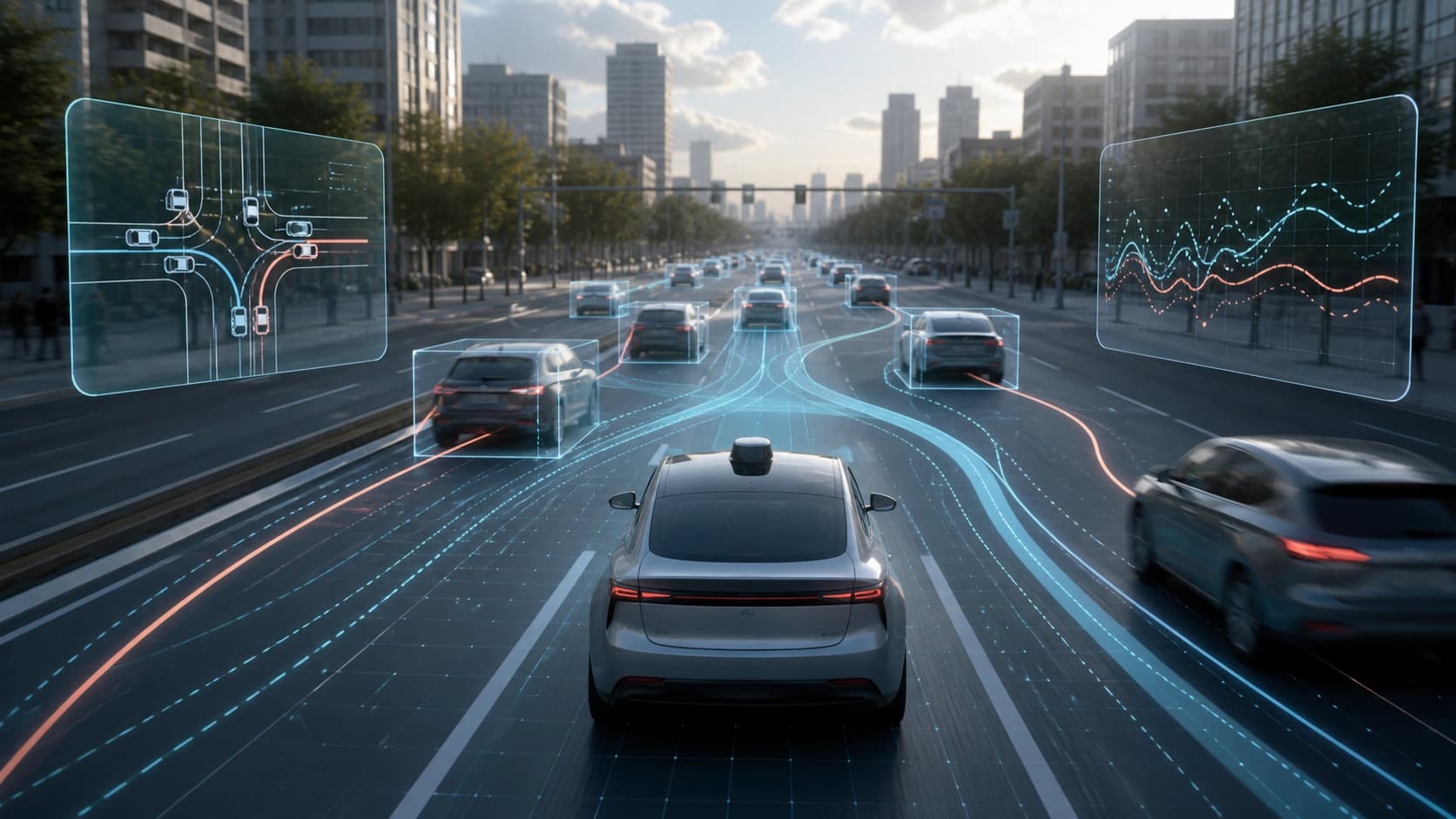
Dense traffic isn't just the movement of cars—it's a constant unspoken dialogue. A driver reads the intentions of those around them through subtle shifts in position, accelerations, and pauses. This dialogue is harder for an autopilot: classical neural networks predict individual trajectories well, but struggle to explain why a particular behavior was chosen. The MPCFormer method attempts to combine prediction and safety so that the vehicle not only anticipates trajectories but also understands the logic of social interactions on the road.
Why regular models fall short in dense traffic
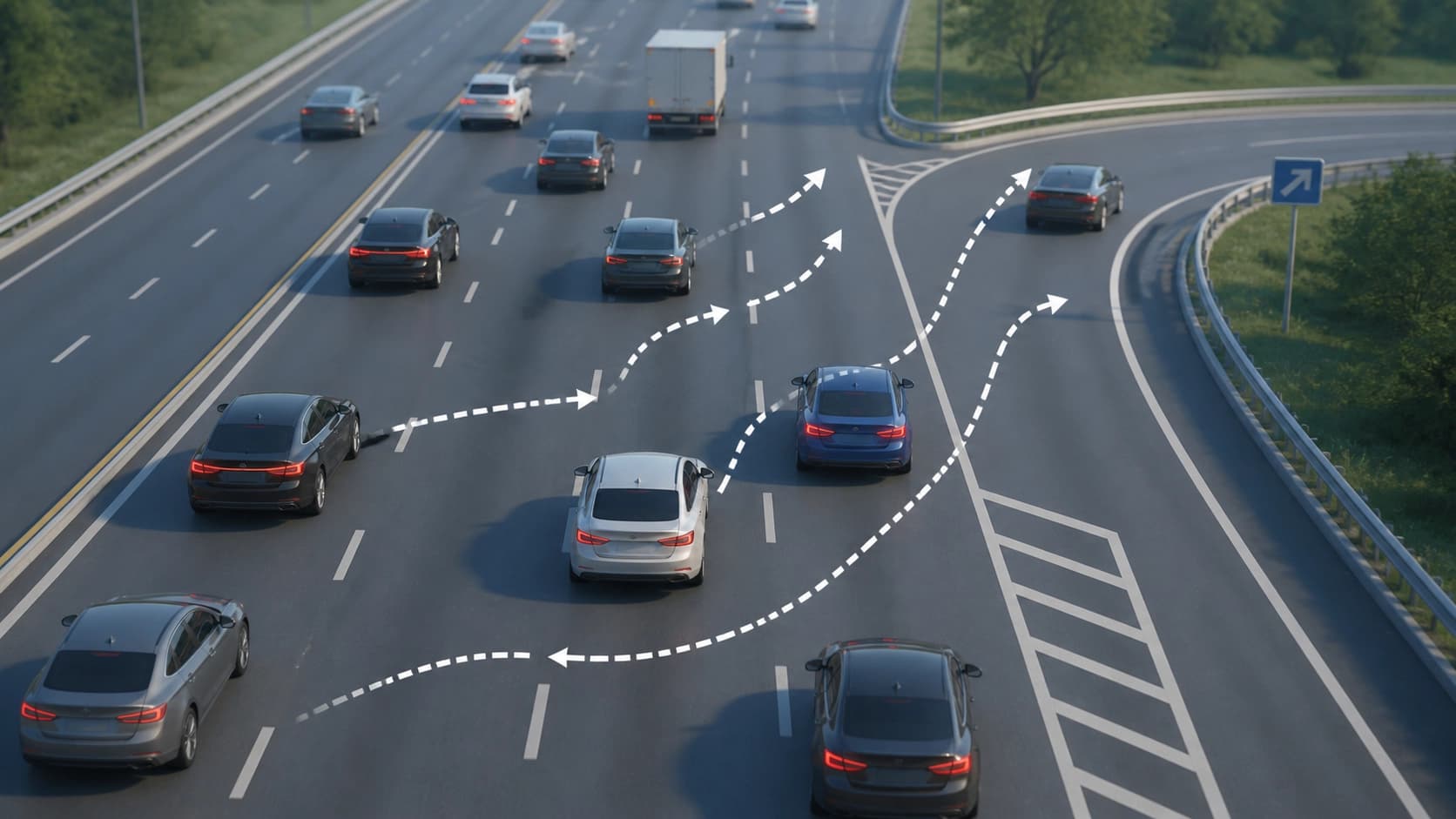
When cars drive bumper-to-bumper and constantly change lanes, the behavior of one participant directly depends on the actions of the others. An error in assessing this interaction leads to two extremes: the autopilot either acts too cautiously and disrupts the flow, or attempts a maneuver at an inopportune moment.
Purely learned planners can replicate driving styles from data, but their internal logic often remains a "black box." In ordinary situations, this is acceptable, but in dense traffic at a highway exit, the cost of an unpredictable decision is too high. Classical control methods, on the other hand, understand the physics of motion well, but don't always account for the fact that other drivers also have goals, react, and yield.
A compromise between physics and data
The approach's authors propose not choosing between physical modeling and machine learning, but combining them. At the core of the MPCFormer method is coupled social interaction dynamics: vehicle states are described not individually, but as a unified system where the actions of one participant change the conditions for all others.
The dynamics are built in a discrete state space, and physical priors are embedded in the model. This keeps intermediate representations interpretable: a specialist can trace which constraints the system bases its decisions on. The dynamics coefficients aren't assigned manually—they're learned by a Transformer encoder-decoder architecture on naturalistic driving records.
According to the researchers, this is the first approach that explicitly models the joint dynamics of multiple vehicles simultaneously, rather than limiting itself to independent predictions.
Why MPC specifically
The learned dynamics give the planner the ability to generate diverse, human-like behavior scenarios: the autopilot can act more assertively or more cautiously depending on the situation. But the neural network alone doesn't guarantee safety.
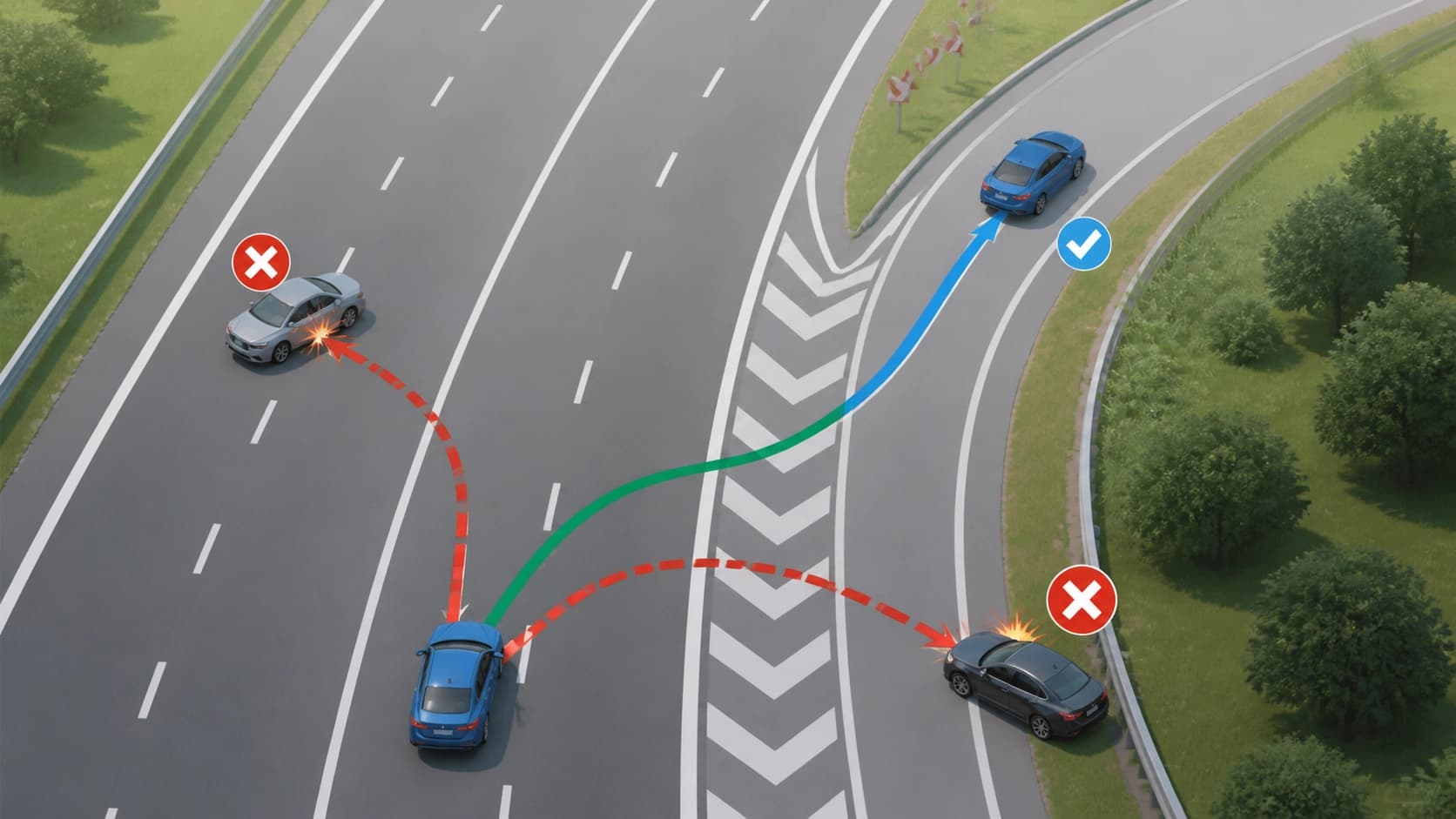
This is where model predictive control—MPC—comes in. It checks generated candidates against constraints and rejects dangerous options before they reach execution. This reduces the risks typical of methods that rely entirely on neural network inference.
What the tests showed
The developers evaluated MPCFormer on the open NGSIM dataset, which contains recordings of real highway traffic. With a prediction horizon of 5 seconds, the average trajectory prediction error was 0.86 meters—the best result among the modern approaches considered.
Closed-loop scenarios with intense interactions were also tested separately: the vehicle needed to perform several consecutive lane changes to make an off-ramp exit in time. Here, the hybrid model also showed a clear advantage over a Reinforcement Learning-based planner:
- 94.67% — share of successfully completed maneuvers;
- +15.75% — improvement in driving efficiency;
- 0.5% — collision rate, compared to 21.25% for the baseline RL planner.
The nearly 40-fold reduction in accident situations is the strongest argument that explainable physical constraints combined with learned social models make an autopilot safer, and its behavior closer to that of an experienced driver.
Frequently asked questions
Related materials
All materials
Toollery: Choose tools for LLM agents from tens of thousands of options without fine-tuning
Toollery builds a search index from descriptions of skills and tools, then passes the model only a limited set of candidates for each query. In experiments with libraries containing tens of thousands of functions, the approach helps maintain selection quality at a fixed top-K, although the overall effect depends on the workload profile and the provider’s caching.
11 November 2026
Step-by-Step Evaluation of GUI Agents for Dashboard Analysis: The DashAct Benchmark
Introducing DashAct, a benchmark of 348 human-verified trajectories that breaks down GUI agents’ work with interactive dashboards into three stages and four visual conditions. The results reveal persistent issues with action prediction and visual target grounding, as well as agents’ reliance on contextual and spatial support.
11 November 2026
WILSON: combining magnifications and patient slides for pathomorphological analysis and report generation
The preprint introduces WILSON, a vision-language model that encodes images of whole slides and series of slides from a single patient at different magnifications, rather than just a single “best” slide. Without task-specific fine-tuning, it outperforms specialized and larger slide models on a range of metrics while requiring substantially less compute, and its diagnostic descriptions received higher ratings from pathologists.
11 November 2026