
MoFE: hybrid of Fourier operators and multi-expert routing for more accurate crypto market forecasts
MoFE's new architecture combines frequency operators and convolutional experts, while a dynamic router adapts the model to different market regimes. On Bitcoin data from 2020–2025, it reduced forecast lag and improved directional price prediction accuracy, as confirmed in simulated trading.

Introduction
Predicting Bitcoin's movement even one day ahead is a challenge that stumps even the most sophisticated algorithms. The cryptocurrency market combines traits of classic financial assets and high-risk speculative instruments: long-term trends, sharp price gaps, and near-random noise all coexist here. Most existing neural networks handle this task only partially: they capture the overall trend reasonably well but react to reversals with noticeable delay. A new approach proposed in a study on arXiv attempts to solve this problem radically differently — using a hybrid of Fourier operators and multi-expert routing. This is the MoFE framework (Mixture-of-Experts with Fourier Neural Operators), developed by Bowen Liu and Mingming Sun. The work was presented at the IEEE ICBC 2026 conference, and the preprint appeared in open access in August of that same year.
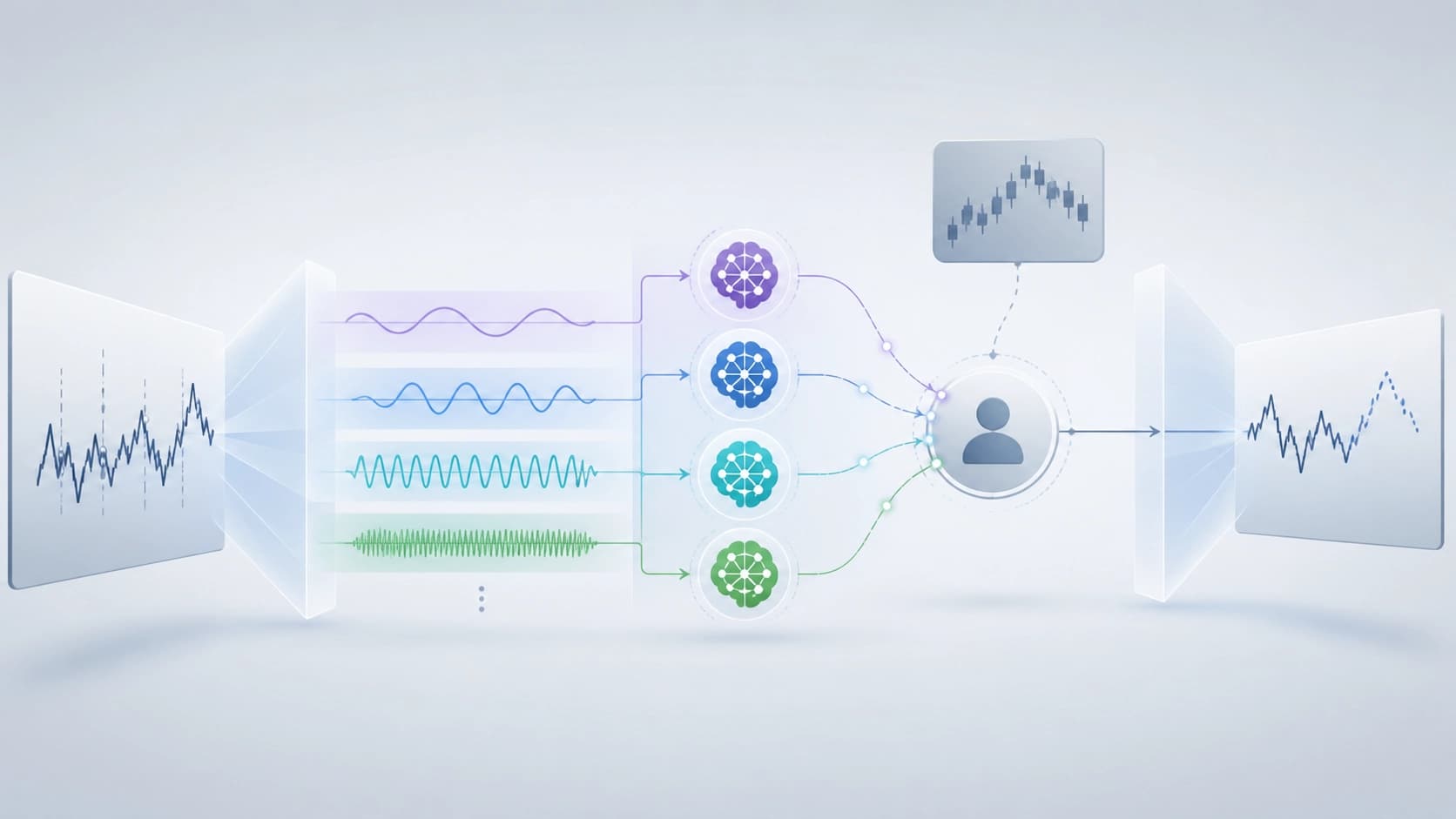
Instead of fitting one universal model to all market states, MoFE uses a pool of specialized experts, each responsible for its own type of price dynamics, and a dynamic coordinator that decides which of them to heed at any given moment.
Why the crypto market is so hard to forecast
Classic time-series forecasting methods — from autoregression to LSTM — assume that data exhibit a certain stationarity at least over short stretches. With cryptocurrencies, this assumption is violated for several reasons at once. First, the market is prone to frequent regime shifts: a calm trend can turn into panic or irrational rally within hours. Second, processes of different scales operate simultaneously within the price series — from multi-year cycles tied to halving events down to second-level microstructural fluctuations. Third, these processes are not statistically independent but form a complex stochastic network.
This is precisely why models trained on historical data often produce time-shifted forecasts. They seem to chase the market rather than anticipate it. Phase lag is especially noticeable on short horizons — a day or a week — where price can change direction several times. In such conditions, simply increasing the depth of a neural network is useless: the error accumulates and leads to even greater delay. MoFE attempts to eliminate this drawback by decomposing the task into spectral components and assigning each one to a separate expert.
How MoFE works
Experts: Fourier and convolutions
The key idea of MoFE is to use the Fourier transform as a way to move from the time domain to the frequency domain. Instead of predicting the next price tick directly, the model learns to map "function to function": it takes not individual points but an entire segment of the time series and outputs another segment, shifted forward. This approach is made possible by Fourier operators — mathematical constructs that work with functions rather than vectors. Inside MoFE, an adaptive version of the Fourier operator (AFNO) is used, responsible for global spectral patterns. Additionally, the model includes convolutional experts operating in two domains at once — both time and frequency. They capture local features and market microstructure that elude purely spectral analysis.
All experts learn continuous mappings, allowing the model to generalize to new market conditions without overfitting to specific historical moments. This "functional" perspective is especially convenient for financial data, where not only exact values matter but also the nature of curve changes.
Dynamic gating
How to decide which expert will perform best at the next moment? For this, MoFE employs a Mixture-of-Experts mechanism. A special gater analyzes the current market state and computes weight coefficients for each expert. In one regime, the spectral expert, capturing the long-term trend, may play a larger role; in another, the convolutional one, sensitive to short-term spikes, takes precedence. The gater is trained together with the experts and over time tunes itself to recognize typical market patterns. Thanks to this, the model can instantly switch strategies without requiring a training restart.
Why it works: stochastic equations
The authors of MoFE relied on the theory of stochastic differential equations when building the architecture. According to this concept, the price of a crypto asset is a solution to an equation in which volatility is not a constant value but a superposition of several oscillatory processes. For example, fundamental price growth is tied to the development of the user network and technology adoption; the seasonal component is driven by mining cycles, difficulty changes, and halving events; finally, the chaotic component is generated by collective trader sentiment.
Each of these components has its own frequency profile, and if the price series is decomposed into such profiles, prediction reduces to extending each oscillation over a short horizon and then superposing the results. This is exactly the operation MoFE performs, combining several specialized experts, each trained on its own frequency band. This avoids the averaging that universal models tend toward while simultaneously smoothing noise without losing important signals.
Experiments and results
To verify effectiveness, the authors conducted experiments on Bitcoin data from January 2020 to December 2025. The model was tested for one-day-ahead (T+1) and five-day-ahead (T+5) forecasting. According to the reported results, MoFE achieves state-of-the-art performance across several metrics. In particular, it shows notably higher directional accuracy in predicting price movement and a better Information Coefficient compared to baseline models.
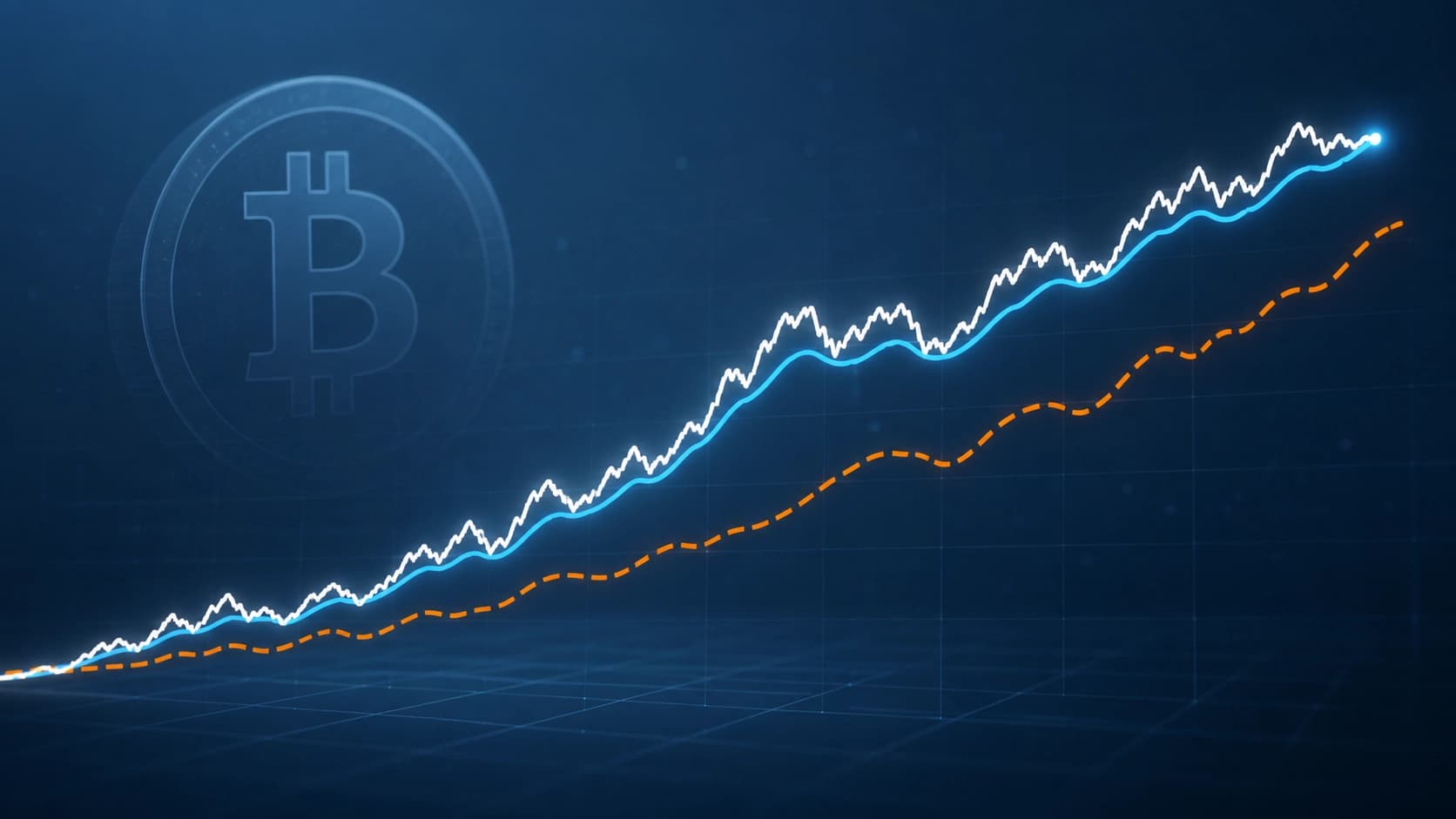
Of particular interest are the trading simulations. When MoFE forecasts were used to make trading decisions in a virtual environment, the model demonstrated substantial excess returns while maintaining a low level of risk, reflected in high Sharpe ratio values. This means the model does not just "guess" the trend but does so consistently, without catastrophic drawdowns. The authors highlight the elimination of phase lag as a key advantage: MoFE forecasts follow price changes with minimal delay, which is critical for real trading where a few hours can cost tens of percent in profit.
Conclusions
MoFE is a step toward a more intelligent approach to forecasting financial markets. Instead of fighting non-stationarity by complicating the architecture, it accepts it as a given and breaks the task into well-understood components. Fourier operators provide a powerful mathematical apparatus for working with functions, while multi-expert routing adds flexibility and adaptability.
The proposed MoFE framework shows that combining two seemingly different ideas — spectral analysis and mixture of experts — can yield a synergistic effect. Further development of the approach will likely involve applying it to other assets, using more diverse experts, and integrating with alternative data such as social sentiment or blockchain flows. But it is already clear: if you want to forecast the crypto market, it is worth paying attention to hybrids like this rather than "universal" models that average out trends and noise equally well.

Frequently asked questions
Related materials
All materials
MathAdv: What the Final Accuracy of Machine-Generated Proofs Conceals
A diagnostic suite of tasks spanning 13 undergraduate and graduate mathematics topics evaluates machine-proving systems in Lean 4 not only by their final results, but also by their subject-matter mastery, the quality of their informal reasoning, and their robustness to rephrased conditions. A component-by-component analysis shows that translating a problem into formal form remains the main obstacle, and that success depends heavily on the area of mathematics and how the problem is framed.
9 November 2026
AffordanceWAM: Affordances as an intermediary between scene prediction and manipulator control
The work describes a generative model that jointly predicts future RGB observations, scalar fields, affordance heatmaps, and continuous robot commands, using human videos to broaden interaction diversity without action annotations or retargeting. On RoboCasa, CALVIN ABC→D, and real-world tasks, the approach delivers consistent gains over RGB-only and robot-data-only baselines.
9 November 2026
Presentation Editing as Controlled Operations: The EditPPT Framework and DeckEdit-Bench Benchmark
The authors break down slide editing into specific objects, permitted actions, and checks to ensure unrelated content remains untouched, rather than relying on free-form code generation. To measure quality, they created DeckEdit-Bench (183 tasks across 28 human-made presentations), and the multi-agent EditPPT framework achieves a 66.7–74.9% task success rate across five base models while preserving over 97% of the content.
8 November 2026