
How iterative reinforcement learning turns failed robot grasps into successful ones
Researchers combined keypoint-based object representation with Deep Q-Network and taught a robot to refine initial grasp candidates to perfection. The method achieved 100% accuracy in simulation on complex objects and confirmed transferability to a real robot.

Why geometry falls short in grasping
Manipulation tasks in robotics rarely fit into a simple "look—calculate—grasp" scheme. Even if a geometric planner correctly determines an object's coordinates, in practice the grasp often turns out to be unstable: the item slips, shifts, or even falls out of the gripper. The reasons include camera inaccuracy, surface properties, micro-irregularities, and even slight movement of the object itself. Traditional algorithms operate on a one-shot principle: they assume a single glance is enough and do not use feedback during the execution of the motion. As a result, the robot repeats the same mistake over and over again.
This is exactly where reinforcement learning comes to the rescue. Instead of trying to find a perfect grasp on the first attempt, the agent learns to gradually adjust its decision, each time observing the outcome and receiving a signal about whether things improved. This iterative approach turns failed attempts into a source of experience rather than a reason for frustration.

How grasp refinement works
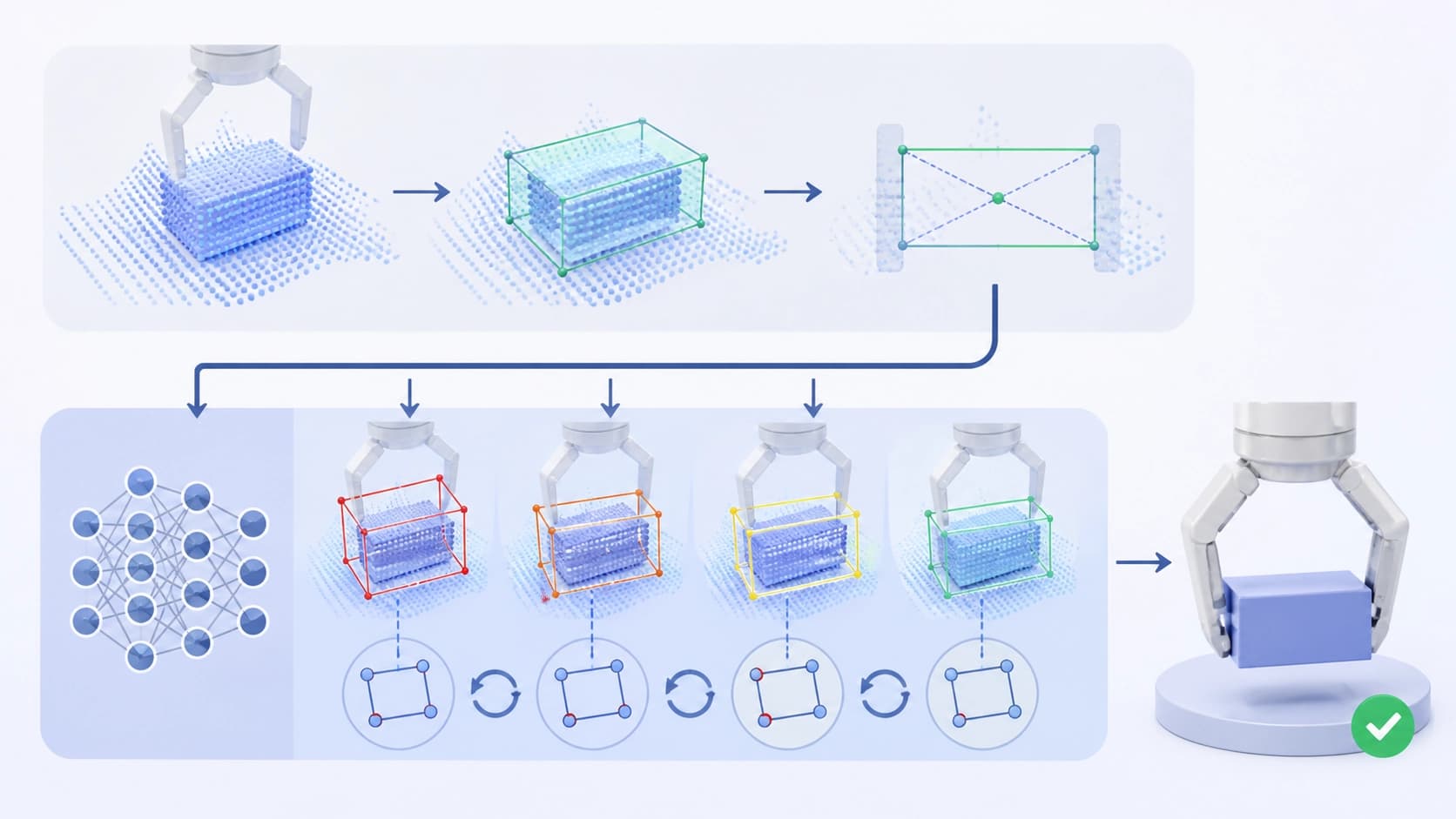
The framework developed by researchers combines two levels of abstraction. At the first level, a classical geometric algorithm working with a two-dimensional top-down image generates several initial grasp candidates. These are coarse poses that could in principle be successful but are not guaranteed to be. At the second level, an agent built on a Deep Q-Network (DQN) comes into play. Instead of analyzing the full image, it uses a compact representation of the object through key points—this reduces the dimensionality of the task and speeds up learning.
The agent operates cyclically. At each step, it evaluates the current grasp pose, decides what small shift or rotation to perform, and receives a reward depending on whether the object has moved closer to stable holding. This step-by-step optimization resembles fine-tuning a motion, where the robot literally "feels out" the correct position. It is precisely this mechanism that gradually turns an initially unsuitable grasp into a successful one.
The role of key points and DQN
The choice of key points is not random. They define the semantic skeleton of the object: corners, face centers, points of contact with the surface. For the agent, this is a convenient way to describe the state of the environment without the noise inevitably present in a raw image. The Deep Q-Network, in turn, is well suited for discrete actions: the agent iterates over a limited set of adjustments and remembers which ones lead to a reward. This approach scales to various objects without the need to rewrite rules for each one.
From simulation to reality: testing on 300 objects
The experiments were conducted in a simulated environment with a UR5 manipulator and a set of 300 objects from Dex-Net. This dataset includes a wide variety of parts—from simple cubes to complex components with rounded edges and recesses. Geometric methods had previously labeled some of these objects as "unsuitable for grasping": it was assumed that the robot could not hold them at all. However, after iterative refinement using reinforcement learning, the success rate reached 100% even on these difficult instances.
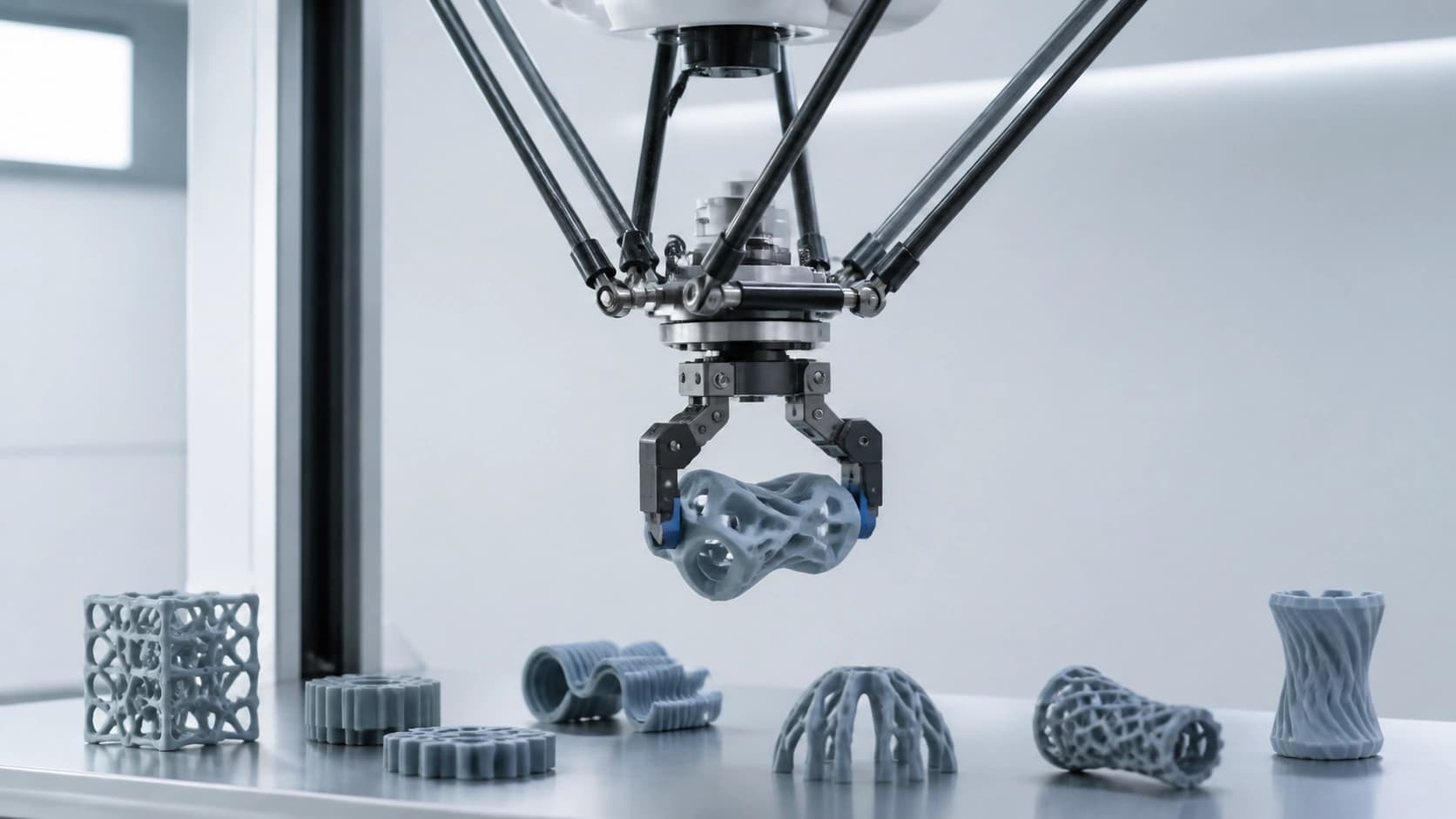
The skills acquired in simulation did not remain on screen alone. A physical experiment on a delta robot confirmed the transferability of the approach: the robot, refining its grasp, confidently manipulated an object that traditional methods considered hopeless. This is an important result, since one of the main challenges of reinforcement learning is the gap between simulation and the real world. Here, the compact representation through key points helped the agent abstract away from irrelevant details and remain functional in real-world conditions.
What this changes in industrial robotics
Iterative refinement based on reinforcement learning changes the very philosophy of grasping. Instead of demanding a perfect answer from the planner on the first try, the system gains the right to make mistakes and the ability to correct them. This opens the door to more flexible contact-rich manipulation, where the robot confidently interacts with unfamiliar or unstable objects. The proposed framework is not a solution for one specific machine but an adaptable foundation that can be reconfigured for new robots and new sets of items. In the near term, this approach has the potential to reduce defect rates in manufacturing and expand the range of tasks available for automation.
Frequently asked questions
Related materials
All materials
STAR: Adaptive Normalization of Temporal Context and Service Graphs for End-to-End Incident Management
The STAR framework trains representations from metrics, logs, and traces, using learnable normalization that accounts for multiscale temporal dynamics and dependency structures between services. On two real-world datasets, this pipeline delivers consistent improvements in anomaly detection, failure ranking, and root cause analysis over state-of-the-art baselines.
10 November 2026
Chern–Simons Reservoir Memory: Autonomous Connectivity Dynamics and Density Transport
The article explores how a reservoir preserves the history of input signals both in its density distribution and in its geometric degrees of freedom. A comparison of four mechanisms shows that current creates a separate connected component that alters the subsequent density response, while accounting for all measured features yields a small improvement in decoding pulse order.
10 November 2026
Validating Candidates Costs More Than Generating Them: Honeypots Against LLM Vulnerability Hunting
The study examines the cost asymmetry in agentic vulnerability discovery: generating candidate versions is cheap, while confirming them through reachability analysis, execution, and PoC development consumes most of the budget, making verification a potential standalone target for defense. The proposed RedHerring—repository-adapted decoys with a hidden certificate—reduced the number of real vulnerabilities found by 38.7–60.4% at equal cost across 33 OSS-Fuzz projects; even after the agent was warned, the reduction remained at 37.2%.
9 November 2026