
Granite Speech 5.0 Turbo CTC: ultra-fast transcription with accuracy down to 4.85% WER
IBM has released two Granite Speech 5.0 Turbo CTC models (470 million parameters each). On H200 accelerators, they transcribe over 210 minutes of audio per second and achieve a WER of 4.85–5.00% on open English-language tests; the encoder-only design is intended for deployment on edge devices.
Compact models for fast transcription
At the end of August 2026, IBM introduced two new speech recognition models with 470 million parameters each — granite-speech-5.0-470m-turboctc and granite-speech-5.0-470m-turboctc-nc. Both variants are compact and designed for on-device speech-to-text. The -nc version, trained on an expanded dataset, is distributed under the CC-BY-NC-SA-4.0 license, while the regular version is under Apache 2.0. The license choice is directly tied to the data: the freely licensed version uses fewer sources, making it easier to integrate into commercial products.
Speed: more than 3.5 hours per second
On an NVIDIA H200 accelerator, the models deliver performance exceeding 12,600 RTFx. With batch processing, this is enough to convert more than three and a half hours of speech into text in one second. This result is achieved thanks to the new architecture and a reduced output rate. To quickly evaluate the model's performance, IBM prepared a streaming demo on WebGPU: it runs directly in the browser, but only Chrome and Edge are supported. The demo shows how the system recognizes speech as audio arrives.
What the leaderboards say
According to the OpenASR Leaderboard data, the aggregated WER for the non-commercial model granite-speech-5.0-470m-turboctc-nc is 4.85%, while the Apache-licensed granite-speech-5.0-470m-turboctc stands at 5.00%. On most tests, the -nc variant proves more accurate, especially on the SPGI Speech set. However, on the segmented Earnings22, it noticeably trails the freely licensed version. In the FFASR Leaderboard, updated on August 25, 2026, the -nc model ranks fifth, and the Apache version ninth. Both models are named the fastest among the participants.
Encoder-only architecture
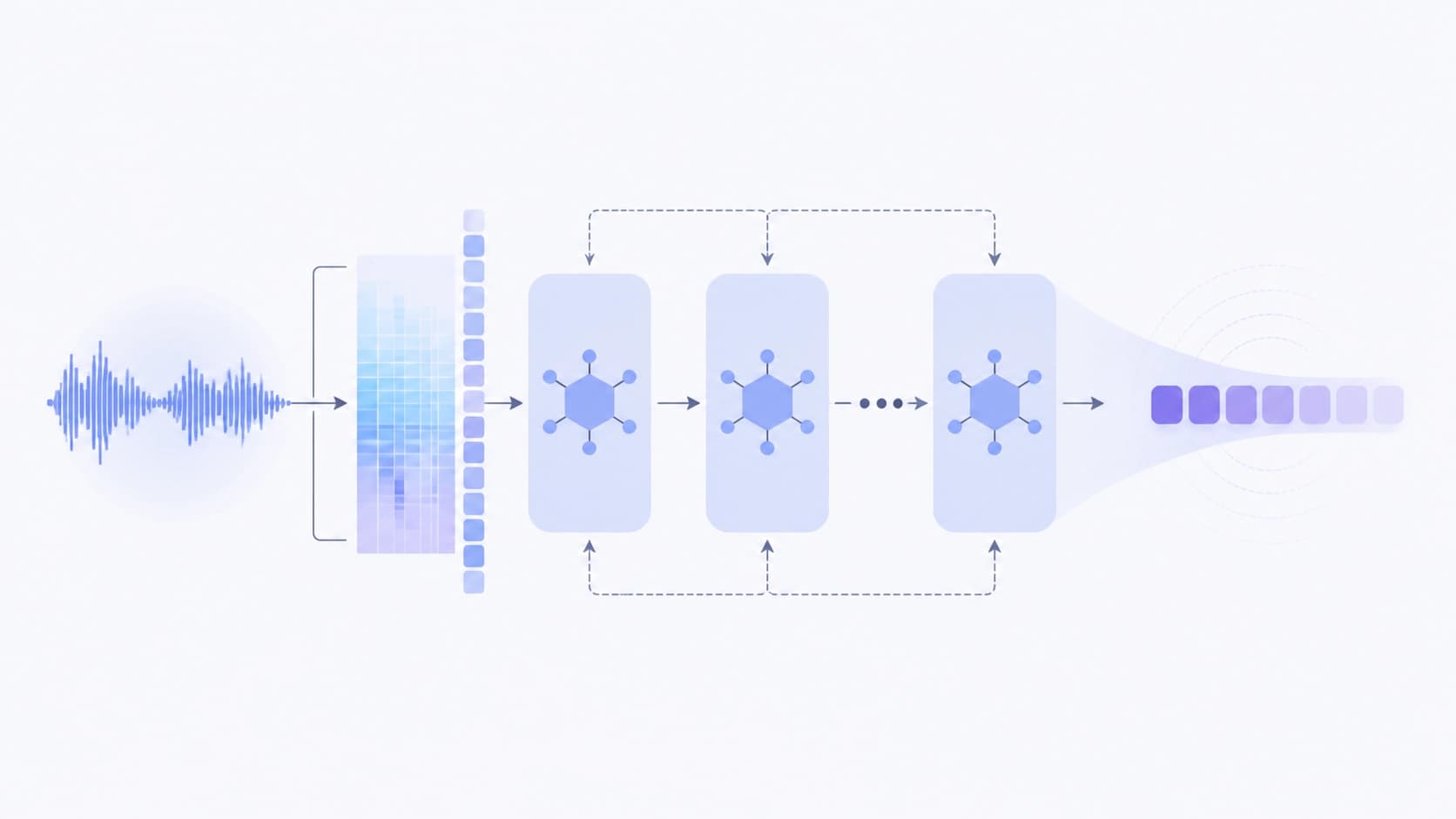
Unlike previous versions in this line, the new models are simpler: they have no separate language module. The core consists of 16 Conformer blocks, with self-conditioning applied at the output of the eighth block. Chunkwise attention prevents quadratic growth in computation, and training minimizes CTC loss. The output stream is reduced to 12.5 tokens per second instead of the 50 characters of earlier encoders. The tokenizers differ between the models: granite-speech-5.0-470m-turboctc uses BPE, while granite-speech-5.0-470m-turboctc-nc uses SentencePiece.
To reduce the input log Mel-spectrogram rate from 100 frames per second to the target 12.5 tokens, three stages of subsampling with a stride of 2 are applied. First, features are packed using a reshape operation, then convolutions with stride=2 are placed in the first two Conformer blocks. Residual connections in these blocks also reduce resolution by averaging neighboring positions.
Trade-offs and applications
Dropping the language model yielded a more than 20-fold increase in throughput compared to earlier models, while the size remained modest at 470M parameters. However, this came at the cost of features that an LM provides: the new models do not support speech translation or keyword biasing. Their primary purpose is therefore high-speed transcription at the edge, where low latency matters and broad language capabilities are not required. Both natural and synthetic data were used for training; among open sources, the MLS dataset with 44,600 hours was employed — it was used for both versions.
This combination of speed and accuracy makes the models well-suited for real-time work: they fit subtitles, meeting recordings, and any scenario where text needs to be generated locally without delays.
Frequently asked questions
Related materials
All materials
Toollery: Choose tools for LLM agents from tens of thousands of options without fine-tuning
Toollery builds a search index from descriptions of skills and tools, then passes the model only a limited set of candidates for each query. In experiments with libraries containing tens of thousands of functions, the approach helps maintain selection quality at a fixed top-K, although the overall effect depends on the workload profile and the provider’s caching.
11 November 2026
Step-by-Step Evaluation of GUI Agents for Dashboard Analysis: The DashAct Benchmark
Introducing DashAct, a benchmark of 348 human-verified trajectories that breaks down GUI agents’ work with interactive dashboards into three stages and four visual conditions. The results reveal persistent issues with action prediction and visual target grounding, as well as agents’ reliance on contextual and spatial support.
11 November 2026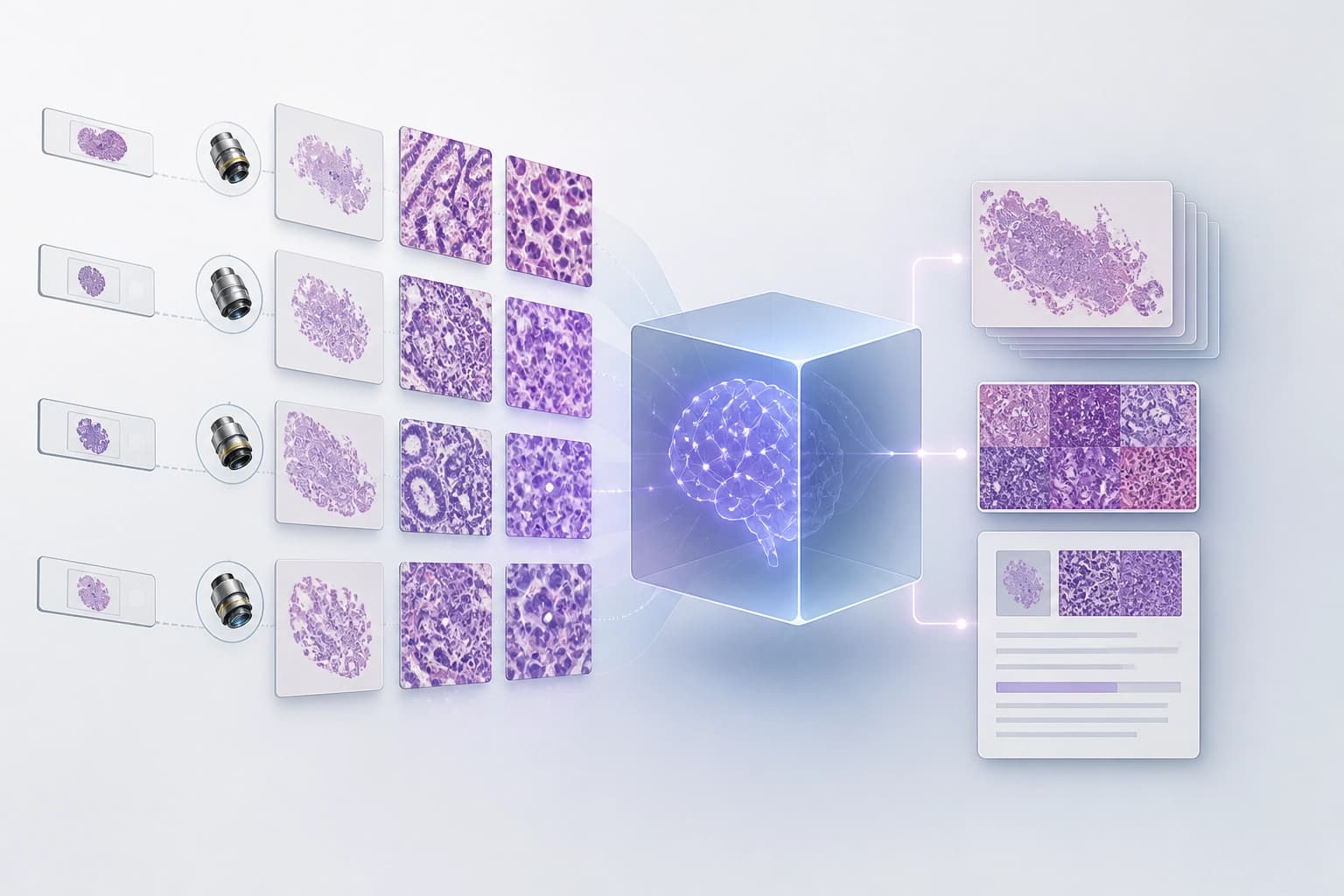
WILSON: combining magnifications and patient slides for pathomorphological analysis and report generation
The preprint introduces WILSON, a vision-language model that encodes images of whole slides and series of slides from a single patient at different magnifications, rather than just a single “best” slide. Without task-specific fine-tuning, it outperforms specialized and larger slide models on a range of metrics while requiring substantially less compute, and its diagnostic descriptions received higher ratings from pathologists.
11 November 2026