Result: fewer manual edits, more prototypes
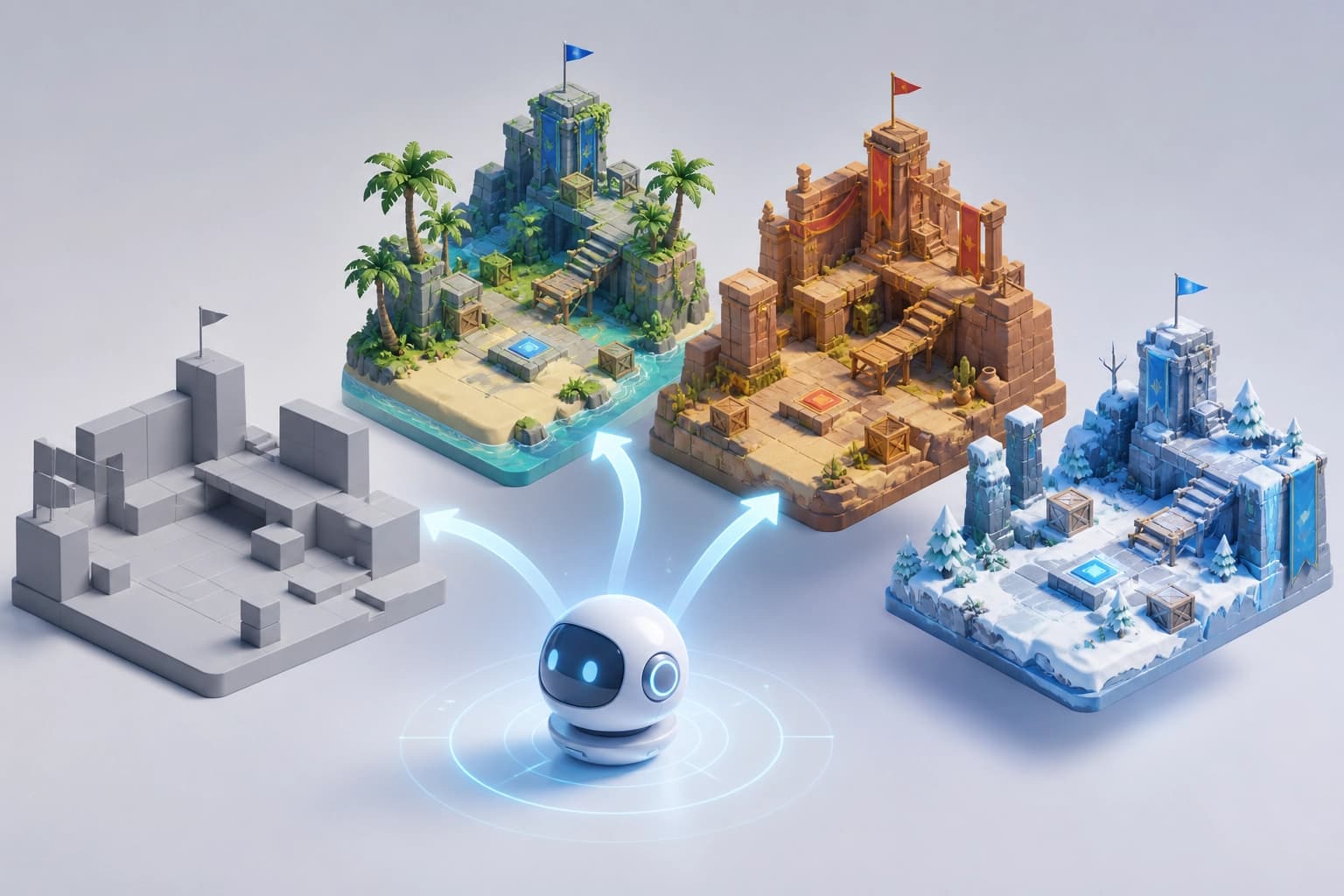
Playco cut manual edits in game prototyping by 50%. The company used GPT-6 Astra. With the previous model, the team spent more time on manual fixes. The new result — three themed prototypes from a single grey box.
Key metrics:
- 50% fewer manual fixes than with the previous model.
- 3 themed game prototypes from a single grey box.
- Most prototypes worked on the first try.
- One cyberpunk variant needed a performance fix.
Practical criterion: look at the share of manual edits and the number of playable variants produced from a shared base. These two metrics directly show how much the model speeds up prototyping.
From one grey box to three game worlds
The process starts with a grey box — an unpolished prototype made of simple primitives. The Playco team ran several iterations on gameplay and creative details. Then, from the shared base, it developed three themed prototypes. GPT-6 Astra produced all three in a single pass.
Steps:
- Assemble a grey box from simple primitives.
- Run iterations on gameplay and details.
- Generate three themed prototypes from the shared base.
- Verify that most work on the first try.
- Fix performance in the cyberpunk version.
Takeaway: one base yields several playable variants. The team can compare more ideas without rebuilding each prototype from scratch. The criterion for choosing a tool is its ability to hold a shared base and generate different themes from it.
Why writing code isn't enough for a model
In game development, a model must reason about space, visual references, adaptive interfaces, and game feel. It's also important to understand whether a change works when the game is played. Playbot lets the model build in the engine, run tests, find bugs, and improve what it has created.
Comparison of the previous model and GPT-6 Astra:
| Criterion | Previous model | GPT-6 Astra |
|---|---|---|
| Manual edits | Engineers fixed the game by hand | 50% fewer |
| Grey box | Less polished | The first prototype is already strong |
| Spatial reasoning | — | Improved |
| Reference recreation | — | Improved |
| Adaptive UI in Unity | — | Improved |
| Game feel | — | Improved |
| Bug detection | — | Found them more easily |
Practical criterion: the model should not only suggest code but also verify the result in the engine. Improvements in spatial reasoning, references, UI, and game feel show exactly where the value grows.
Playbot as an environment for verifying changes
Playco uses GPT-6 Astra in developing Playbot. It's an AI-powered IDE for professional game developers. It connects directly to engines such as Unity and Godot. AI models can edit scenes, play and test games, verify changes, and work in parallel inside the tools developers already use.
Playbot capabilities:
- Editing scenes in the engine.
- Launching the game and testing.
- Verifying changes.
- Working in parallel inside existing tools.
Playbot lets the model play the game and verify its own changes. That's why Astra found bugs and opportunities to improve the player experience more easily. The criterion for choosing: the tool should integrate into the current engine and give the model the ability to verify the result in practice.
What this means for working with ideas
For Playco, the main effect is the ability to turn more ideas into something developers can play and compare. The company says that with ten game ideas, you can make all ten. Then you can play them and see how they feel, rather than just imagining it.
Practical criterion: a tool is valuable when it speeds up the transition from idea to playable comparison. It helps not only generate code but also verify how a change feels in the game. Then the team spends fewer manual edits on each prototype.