
Impressed by Jane Street, Etched raised a new round and increased its valuation to $21 billion.
Etched raised $700 million at a $21 billion valuation, with Jane Street as the lead investor, which has already installed the company's first system and was pleased with early tests. The valuation grew by nearly $11 billion in a month: it stood at $10.3 billion in July and $5 billion in December.

The market believes in Etched's architecture
Startup Etched, which develops specialized AI inference solutions, has closed a new funding round. The company raised $700 million, and its valuation reached $21 billion. The round was led by Jane Street, an investment firm known for its skepticism toward flashy AI projects. The fact that it became the lead investor speaks volumes: Etched managed to convince a conservative player of the real value of its technology.
This is already the third notable valuation increase in a short period. Last December, Etched was worth $5 billion. In July, the company closed a Series C round of $300 million at a valuation of $10.3 billion. Now investors have doubled the value in literally a month — a jump of nearly $11 billion. Such rapid growth is rare even in the overheated AI infrastructure market.

What exactly Etched's engineers came up with
Etched doesn't just sell chips — the company delivers complete systems it calls "frontier inference clusters." These are ready-made clusters for running the heaviest models, which can no longer be called standalone accelerators. Co-founder and COO Robert Wachen told TechCrunch that the team designed two new components that speed up inference at its two key stages.
Prefill stage: low voltage instead of fighting heat
When a model processes an input request, the first stage is prefill — "parsing" the prompt and preparing internal states. This is where Etched took an unconventional approach: instead of pushing frequencies higher and painstakingly cooling the die, the engineers made a chip that operates at low voltage. This allows significantly more transistors to be placed on the board without hitting thermal limits. Compute density grows, and overheating no longer becomes a bottleneck.
Decode stage: cluster-scale memory
The second stage is decode, i.e., generating the response. Here, the bottleneck is usually memory access: each new token requires fast data exchange between compute blocks. To address this, Etched created a new type of memory and interconnect called cluster-scale memory. The idea is that many chips are connected into a single network and share memory with high speed and low latency. Essentially, the entire cluster operates as one giant accelerator rather than a set of separate devices.
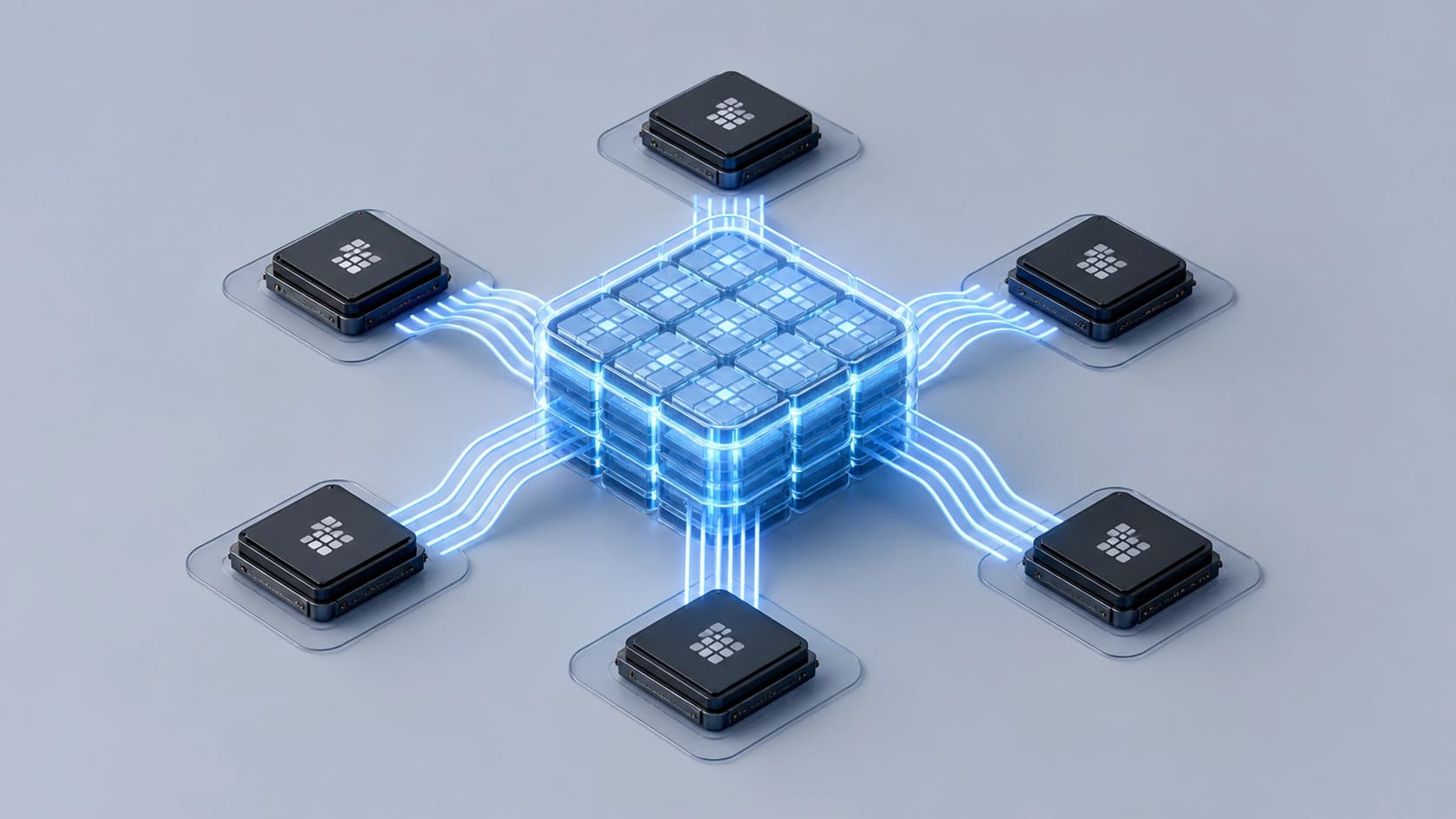
There were earlier rumors that Etched permanently hardwires a specific model into silicon and therefore couldn't adapt to new architectures. The company has refuted these concerns: current systems can run any frontier models, meaning the most advanced general-purpose neural networks.
Why Jane Street decided to make a big bet
For Jane Street, participating in the round is not just a financial injection. The firm stated that it conducted its own testing of the chip and was pleased with the early results. Moreover, Jane Street now has its own rack of Etched equipment in a data center. This means the investor didn't just take the company at its word — it got access to the hardware and tested it in practice.
The deal itself looks like a vote of confidence in Etched's entire concept. Specialized chips for inference are a risky bet, as the market changes quickly and large language models evolve. But the combination of a low-voltage prefill chip and scalable cluster memory gives Etched arguments for competing with general-purpose accelerators.
In addition to Jane Street, investors familiar from previous deals also participated in the round: Kleiner Perkins, Sequoia Capital, Andreessen Horowitz, Tiger Global, Bain Capital Ventures, Primary, Positive Sum, Diffusion, Argo, Blackstone, as well as Peter Thiel and Neo, Stripes. A solid lineup — from classic venture funds to major financial players.
The company promises its customers higher inference speed and lower costs compared to traditional solutions. If the claimed characteristics hold up under real production workloads, $21 billion may turn out not to be the peak, but merely an intermediate milestone.
Frequently asked questions
Related materials
All materials
Checking LLM Hallucinations via SQL-Based Source Representation Without Fine-Tuning
The study examines whether an LLM can apply a basic symbolic skill—building a SQL database from source documents—to ground its outputs in sources without supervision when detecting hallucinations. On RAGTruth and DiaHalu, this neuro-symbolic pipeline proves more accurate than direct prediction and comparable to state-of-the-art methods, without requiring domain-specific fine-tuning.
9 November 2026
MathAdv: What the Final Accuracy of Machine-Generated Proofs Conceals
A diagnostic suite of tasks spanning 13 undergraduate and graduate mathematics topics evaluates machine-proving systems in Lean 4 not only by their final results, but also by their subject-matter mastery, the quality of their informal reasoning, and their robustness to rephrased conditions. A component-by-component analysis shows that translating a problem into formal form remains the main obstacle, and that success depends heavily on the area of mathematics and how the problem is framed.
9 November 2026
Presentation Editing as Controlled Operations: The EditPPT Framework and DeckEdit-Bench Benchmark
The authors break down slide editing into specific objects, permitted actions, and checks to ensure unrelated content remains untouched, rather than relying on free-form code generation. To measure quality, they created DeckEdit-Bench (183 tasks across 28 human-made presentations), and the multi-agent EditPPT framework achieves a 66.7–74.9% task success rate across five base models while preserving over 97% of the content.
8 November 2026