
How ChatGPT works: key features, subscription plans, and where to use it
We break down what the OpenAI chatbot can do: from text and code generation to working with images and third-party services. We assess its strengths, limitations, and typical use cases, and also compare it with alternatives like Claude.
What is ChatGPT
ChatGPT is a chatbot from OpenAI that carries on a conversation almost like a live interlocutor. It is built on natural language processing: the model understands requests, grasps meaning, and responds with detailed messages. It belongs to generative AI: it can not just search for information, but create new content — texts, code, letters, ideas.
The name — Generative Pre-trained Transformer — reflects the essence: it is a transformer pre-trained on vast amounts of data. First, the model absorbs patterns from millions of texts, and then, through deep learning and reinforcement learning from human feedback, learns to give more accurate and useful answers. The public launch took place in November 2022, and since then ChatGPT has become one of the most talked-about AI systems.
Key features
ChatGPT's main strength is understanding context and nuances. It handles ambiguous wording and can keep a conversation going by remembering a limited number of previous replies. That is enough to conduct a focused dialogue, but not indefinitely.
The model's capabilities go far beyond messaging. With it, you can:
- write and debug code;
- compose music and poetry;
- generate business ideas;
- simulate chat rooms or game scenarios.
For ChatGPT Plus subscribers, additional options open up: image generation via DALL-E 3 and expanded limits for using GPT-4. This makes the system multimodal — it works with both text and images. There are also plugins: Expedia can be used to book trips, OpenTable to reserve restaurant tables, and the integration with Zapier automates routine workflows. Users can rate responses, and OpenAI uses those ratings to further train the model.
How it works
Inside ChatGPT is a large language model. It is trained on massive corpora of texts to predict the next word or phrase in response to a request. That is why responses look natural and coherent: the model does not simply search a database, but constructs new text based on learned patterns.
Where to use it
There are quite a few practical scenarios. Here are the main areas:
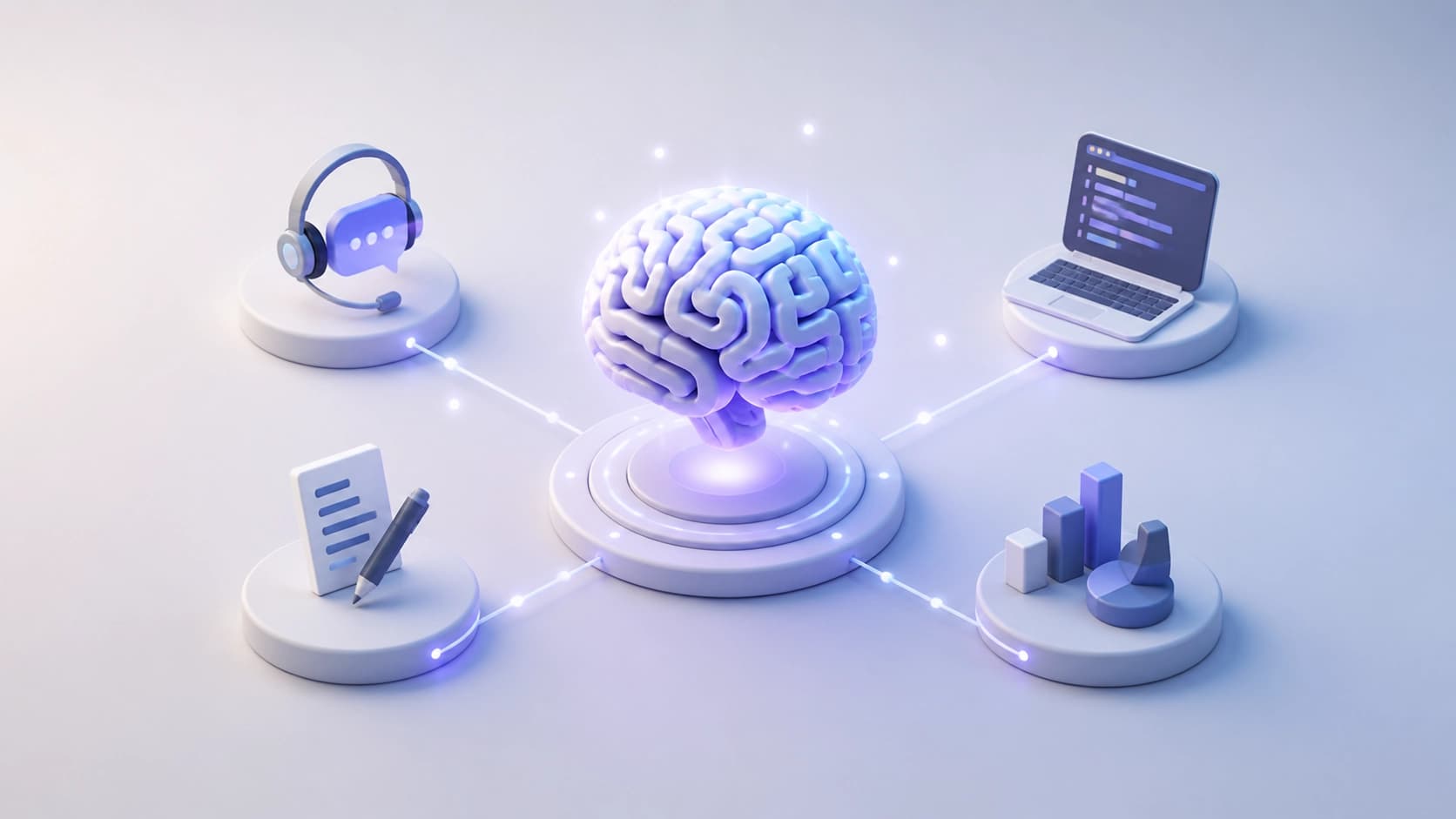
- customer support automation: the bot answers common questions and relieves operators;
- content creation: helps write blogs, articles, and social media posts;
- data analysis: summarizes documents, extracts insights, and gives recommendations;
- code debugging: explains errors and suggests fixes;
- language translation;
- personalized recommendations.
Using ChatGPT saves time and resources — routine tasks no longer require manual work. The model gives human-like answers, handles complex search queries, and can be fine-tuned for a specific industry. At the same time, it keeps improving, which reduces the burden on people and decreases the number of errors.
Subscription plans and alternatives
The basic free option provides access to the base version of the model. The paid ChatGPT Plus subscription expands the functionality: besides DALL-E 3, it includes priority access to GPT-4 and additional capabilities. OpenAI is constantly updating the lineup — for example, a newer model, GPT-5.5, is also mentioned, which is aimed at work tasks: it better understands complex goals, can use tools, check its own work, and perform multi-step operations such as coding, research, and working with documents.
As for alternatives, Claude from Anthropic stands out. It is distinguished by empathy and attention to ethical aspects, and its context window reaches 200,000 tokens — which makes it possible to process very large texts. The choice between ChatGPT and Claude depends on the task: the former is often preferred for its breadth of features and ecosystem, the latter for its accuracy and long context.
In the end, ChatGPT can be seen as a universal assistant for both everyday tasks and professional work. And the availability of plugins, multimodality, and different subscription plans makes it a flexible tool that adapts to the needs of a specific user.
Frequently asked questions
Related materials
All materials
Chern–Simons Reservoir Memory: Autonomous Connectivity Dynamics and Density Transport
The article explores how a reservoir preserves the history of input signals both in its density distribution and in its geometric degrees of freedom. A comparison of four mechanisms shows that current creates a separate connected component that alters the subsequent density response, while accounting for all measured features yields a small improvement in decoding pulse order.
10 November 2026
Diversity in the Input, Not in the Reasoning: Comparing Test-Time Augmentation Methods for LLMs
The study compares sources of variation in LLM inference—query paraphrasing, spelling changes, and image transformations—at an equal number of calls. Across six benchmarks, preserving meaning yielded the greatest improvement in accuracy, while character-level noise and simultaneous perturbations of two modalities were less useful.
8 November 2026
Neptuna: Comparing ML Architectures for Compressible Multiphase Flows with Discontinuities
Introducing Neptuna, a large-scale benchmark with 3 TB of computations for bubble collapse and droplet breakup under shock waves, evaluating convolutional, spectral, transformer, and pretrained PDE models. The takeaway: there’s no universal leader, while composite loss functions and SoftAdapt help better preserve interfacial boundaries and reproduce the spectrum more accurately.
6 November 2026