
Future iPads may get a physical camera button: what Apple's new patent suggests
Apple has filed a patent for a pressure-sensitive camera control button that would allow changing settings with touches, swipes, and press force. The technology is intended for tablets, but the company has not yet confirmed plans to release such a device.
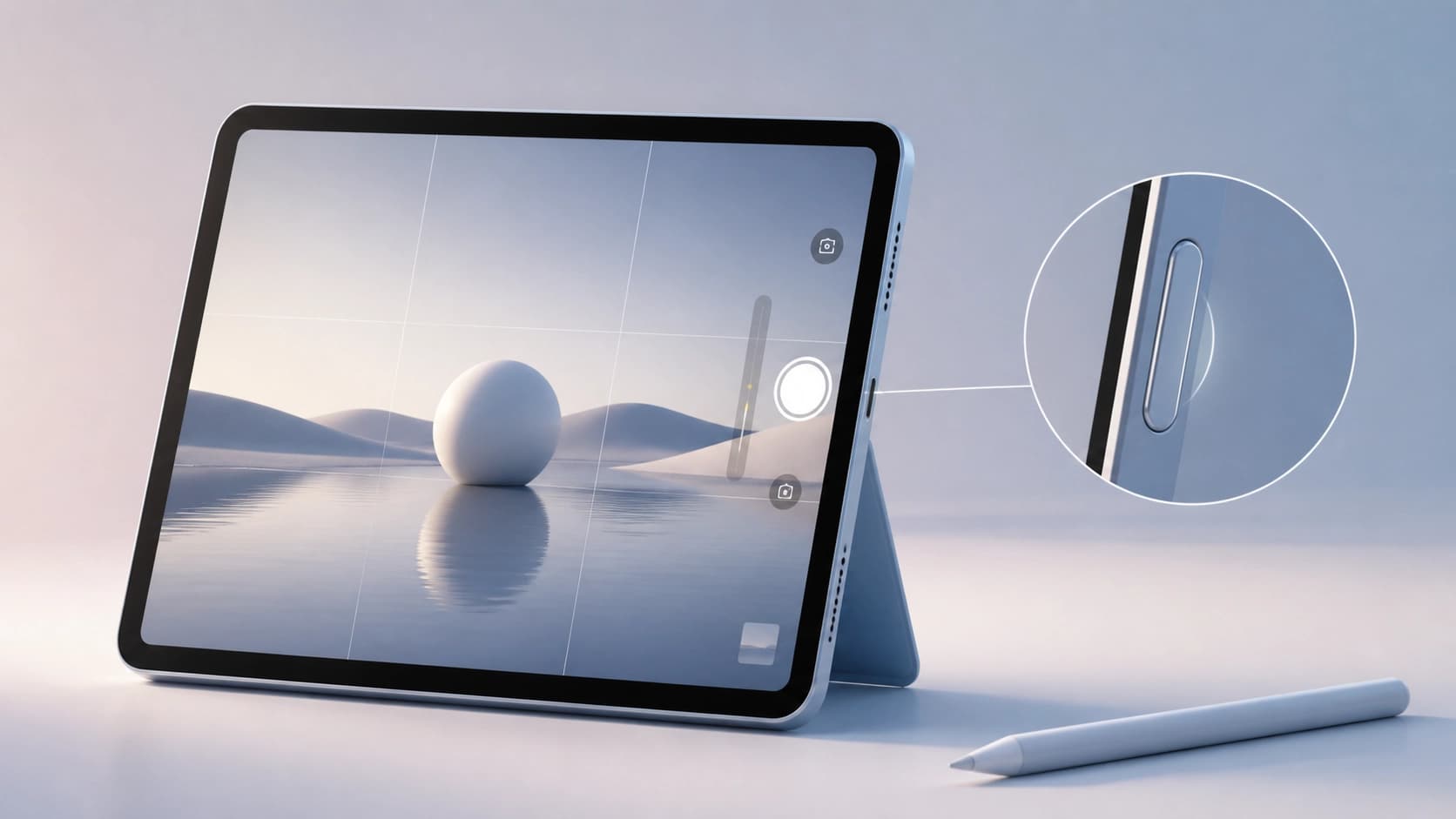
A patent that could change camera control on the iPad
Apple continues to patent ideas that may one day find their way into real devices. The latest application — titled "Input System for Portable Electronic Device" — describes a physical button for controlling the camera on a tablet. The application was published by the patent office on August 18, and although Apple has not confirmed the release of an iPad with such a feature, the document gives plenty of food for thought.
Unlike regular volume or lock buttons, this is not just a switch. According to the patent text, it is a pressure-sensitive element capable of distinguishing the force of a press and even detecting the position of a finger on its surface. In essence, this is an attempt to transfer the logic of on-screen camera controls to a physical medium.
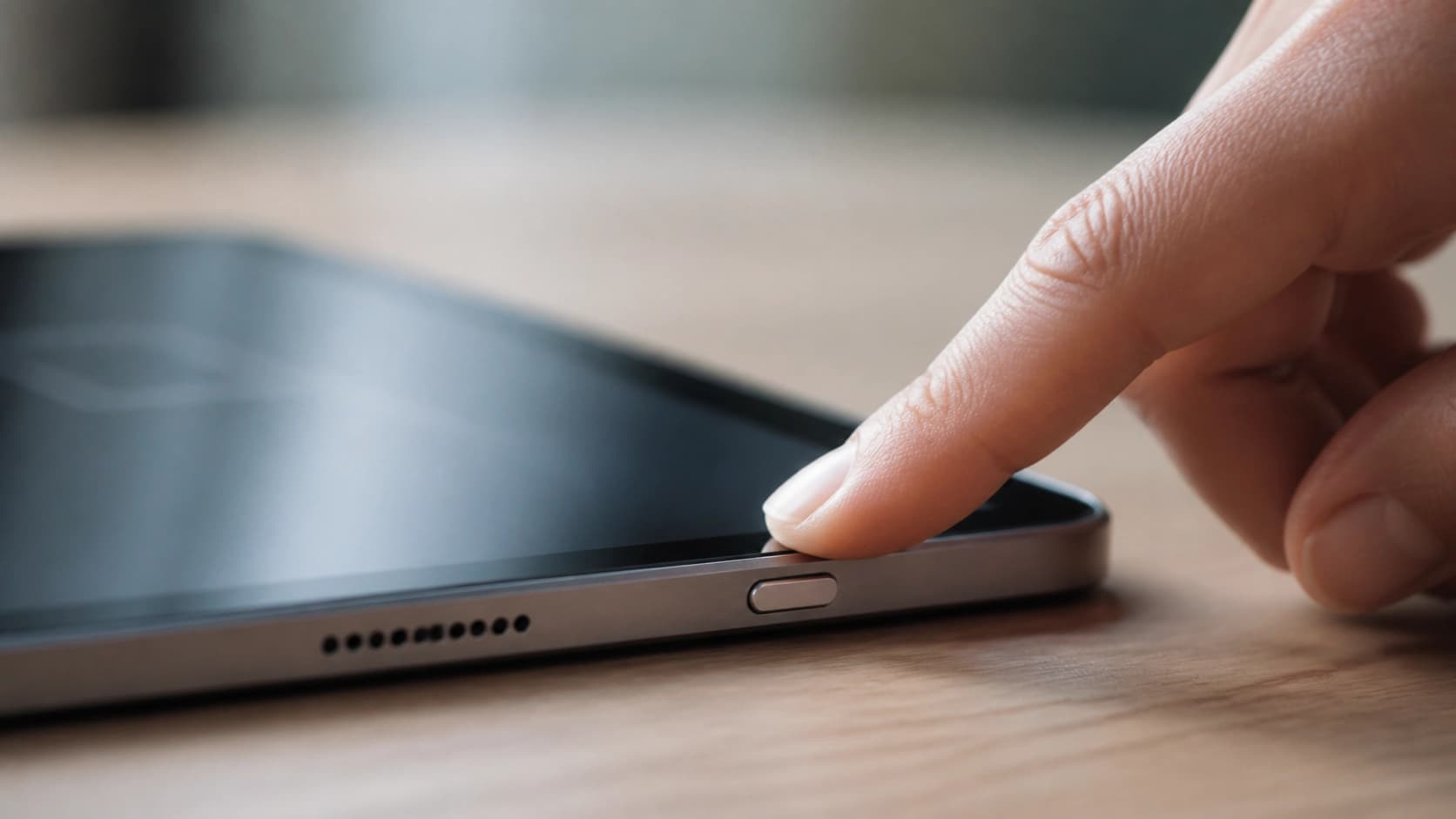
How the future button works: technical details
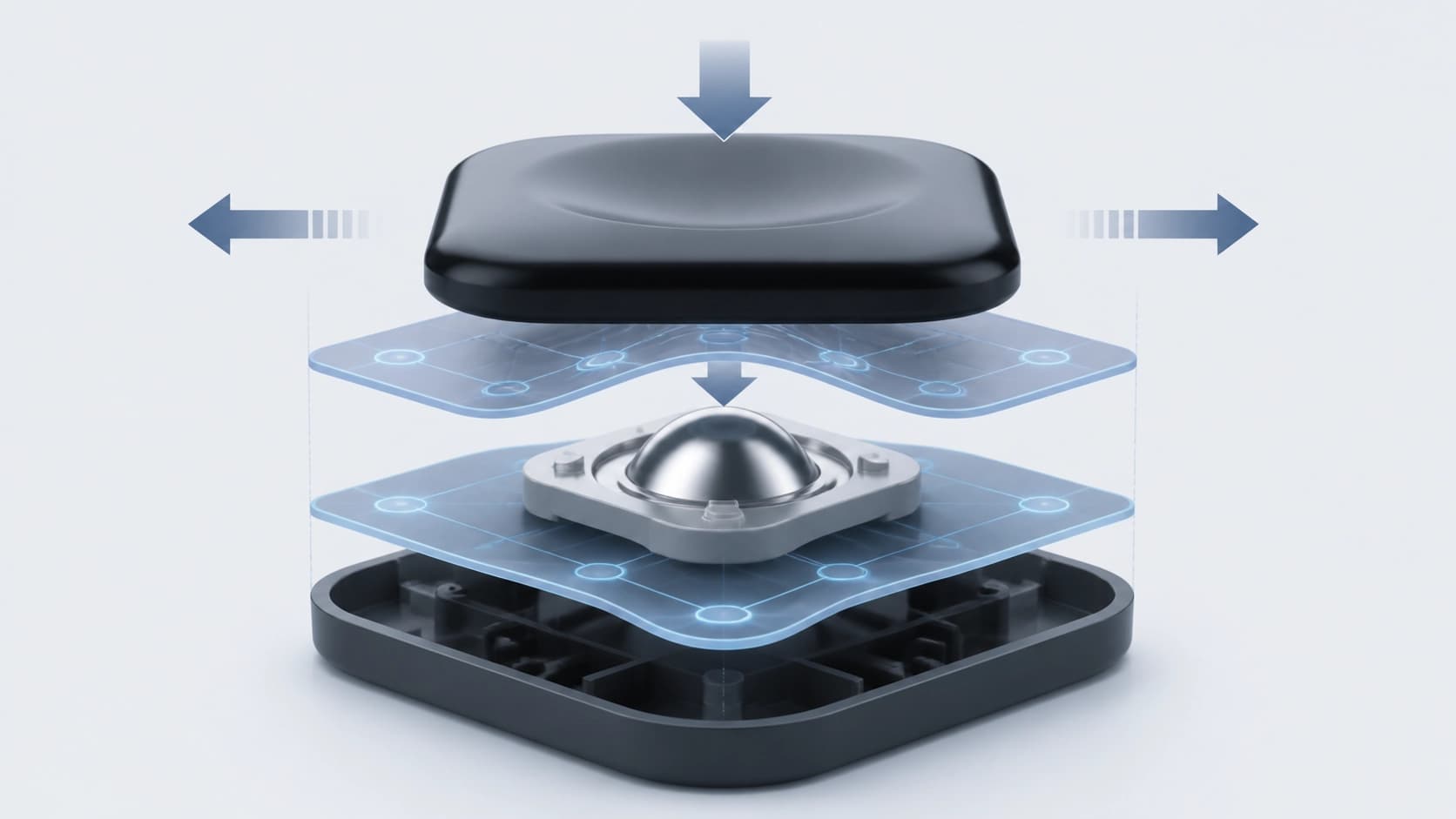
The patent materials describe a structure consisting of two deformation-sensitive elements. They allow measuring the force and point of pressure application along the entire length of the button. Additionally, a dome switch is provided — it activates with more intense pressing, providing tactile feedback. The user will receive confirmation of an action not only visually but also physically — the tablet may vibrate slightly or emit a click.
Interestingly, the application specifies concrete force ranges. A light press — from 0.8 to 1.2 Newtons — is suitable for input without extra effort. For more significant commands, such as releasing the shutter, a stronger press is required: the threshold is set in the range of 3.0 to 4.0 Newtons. Between these levels, the button can recognize intermediate states, opening up broad possibilities for customization.
But force is not the only parameter. The patent suggests using swipes across the button's surface: a light finger movement left or right could change shooting parameters — for example, zooming in on a subject or switching modes. This is especially important for tablets, which are not always convenient to hold with one hand: controlling the camera without needing to reach for the screen significantly simplifies the process of shooting, document scanning, or video recording.
What it has in common with Camera Control on the iPhone 16
In 2024, Apple introduced the Camera Control feature with the iPhone 16 lineup — a dedicated physical key on the smartphone's body that responds to presses of varying force and swipes. The new patent application develops the same concept, but with the specifics of large devices in mind. A tablet is bigger and harder to hold with one hand, so a button on the edge could become a more convenient alternative to the touchscreen in situations where you need to quickly take a shot or start recording.
Notably, most of the drawings in the patent depict tablets — the application contains 20 diagrams in total, and only three of them show a smartphone. This could mean that the company's engineers are purposefully adapting the successful iPhone idea to the iPad format, with an emphasis on holding the device horizontally or vertically, as when taking photos.
A patent is not yet a guarantee of a finished product
It is important not to view the appearance of a patent as an announcement. Apple files hundreds of applications every year, and a significant portion of them never turns into commercial devices. The document may describe just one of many experimental directions, and the final decision on release depends on numerous factors: from the cost of implementation to the real benefit for users.
At this point, the company has not officially confirmed plans for an iPad with a physical button for shooting. However, the very existence of such a design with a well-thought-out system for recognizing force and gestures suggests that the direction is being actively explored. If such an element does make it into production tablets, it could noticeably change the familiar camera usage scenario — both for photography enthusiasts and for those who regularly scan documents or shoot video.
Frequently asked questions
Related materials
All materials
Toollery: Choose tools for LLM agents from tens of thousands of options without fine-tuning
Toollery builds a search index from descriptions of skills and tools, then passes the model only a limited set of candidates for each query. In experiments with libraries containing tens of thousands of functions, the approach helps maintain selection quality at a fixed top-K, although the overall effect depends on the workload profile and the provider’s caching.
11 November 2026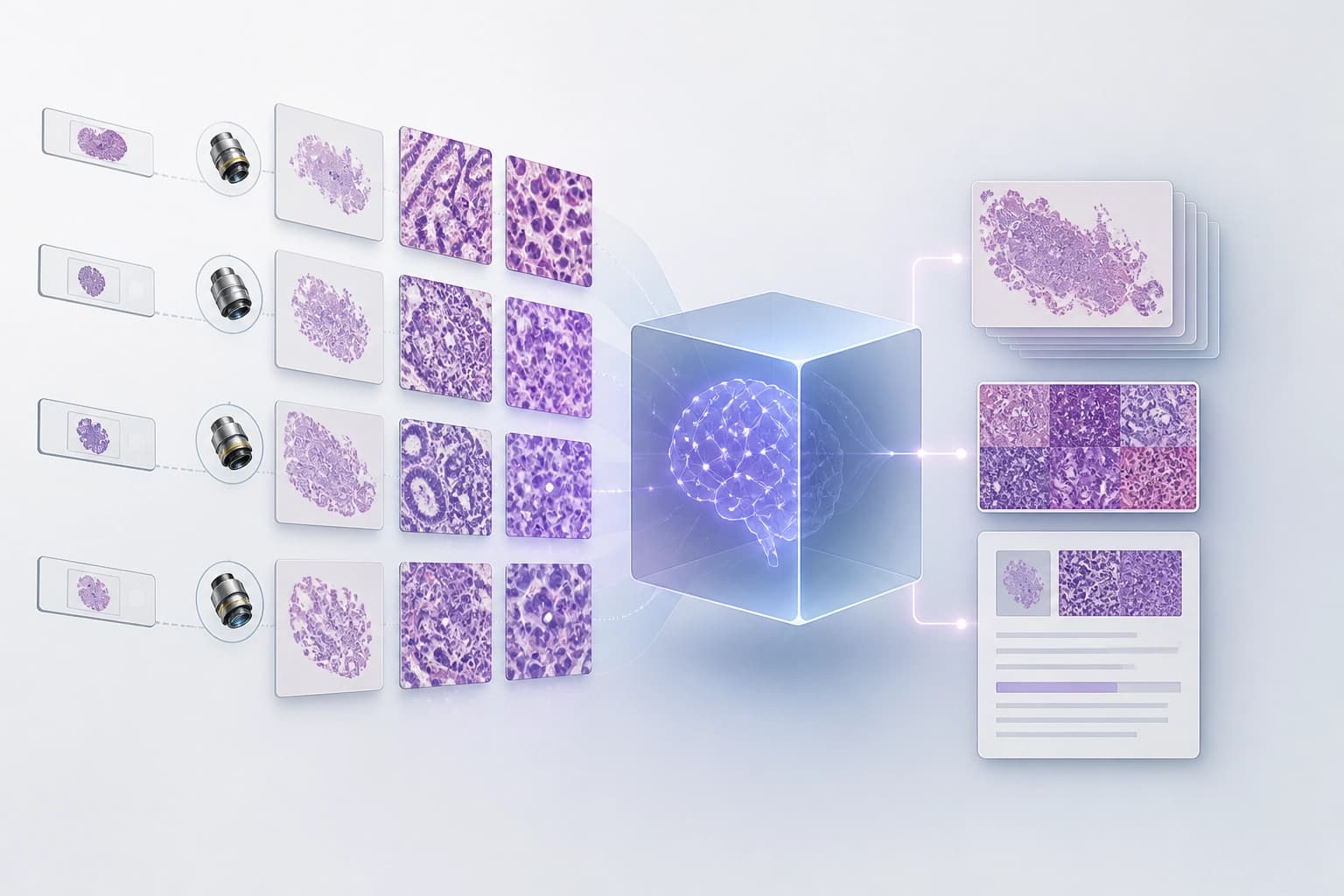
WILSON: combining magnifications and patient slides for pathomorphological analysis and report generation
The preprint introduces WILSON, a vision-language model that encodes images of whole slides and series of slides from a single patient at different magnifications, rather than just a single “best” slide. Without task-specific fine-tuning, it outperforms specialized and larger slide models on a range of metrics while requiring substantially less compute, and its diagnostic descriptions received higher ratings from pathologists.
11 November 2026
Canonical Polynomial Invariants for Diagnosing RL Simulator Failures: Where Are They Actually Useful?
The study examines whether incorporating physical laws into learnable dynamics models is justified: invariants extracted from trajectories and reduced to canonical form using Gröbner bases yield modest forecasting gains, but prove powerful for diagnostics, enabling the localization of violated constraints and identification of specific erroneous parameters.
10 November 2026