
Big scientific breakthroughs are not planned: agentic auto-researchers have much in common with fuzzing
The authors of the new work argue that autonomous scientific systems should rely on dense signals of intermediate progress, as fuzzers do, rather than only on sparse final outcomes. This approach allows the agent to explore unconventional hypotheses and avoid overfitting to the benchmark.
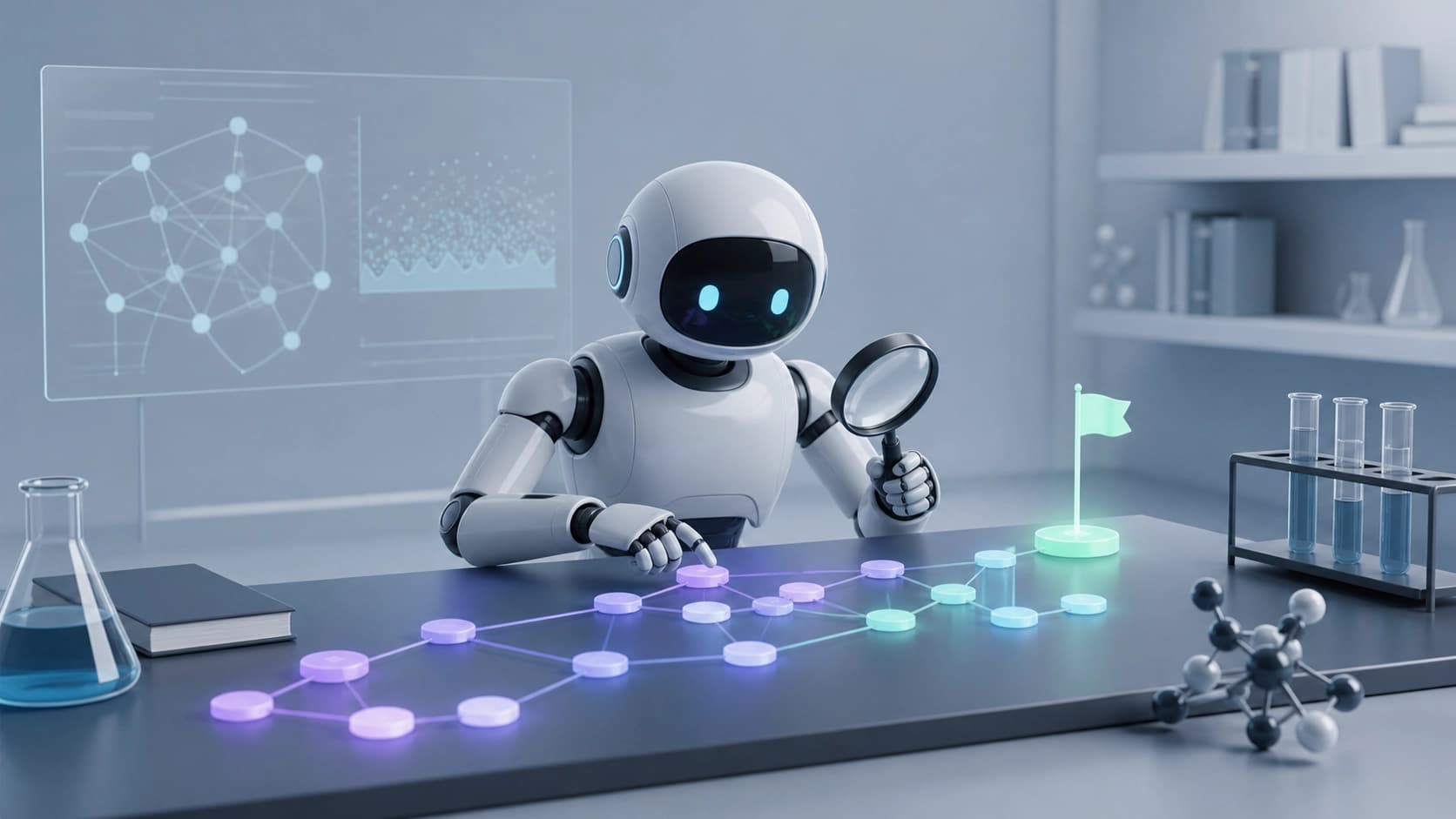
Science has long been full of examples of major discoveries being made despite strict plans: chance observations, unexpected results, and side branches of research are often more valuable than pre-set goals. However, modern autonomous systems built for scientific work are designed on the principle of "give the agent a task and a final metric, and it will reach a breakthrough on its own." A recent preprint on arXiv, presented in August 2026, shows why such a paradigm is doomed: agentic auto-researchers that optimize only the final outcome are essentially doing fuzz testing, but fail to use the main lesson of fuzzers—the value of intermediate coverage signals.

The Illusion of Planned Breakthroughs
In most modern auto-research systems, scientific discovery is treated as an optimization problem. The agent is given a set of experiments, a final benchmark, and it is expected that maximizing the score will lead to new knowledge. The problem is that the final evaluation is a sparse signal. It appears once at the end and says nothing about which intermediate steps were useful. When an agent is rewarded only for the final verdict, it inevitably overfits to the test conditions and begins blindly sampling similar variants, without risking a look into unfamiliar regimes.
This approach resembles an exam where a student is first given a list of questions and then graded only on the correctness of answers, ignoring how they searched for solutions. If a student has memorized typical problems, they will perform well on training examples, but are unlikely to discover a new law of physics. Similarly, agents aimed at a final score find not something new, but only what confirms already known data.
Fuzzing as a Model for Auto-Research
The authors of the preprint draw an unexpected parallel: a research agent solving a scientific problem faces the same sparse feedback as a grey-box fuzzer searching for vulnerabilities in software. A fuzzer does not always find a bug right away. If it received only a "bug/no bug" signal, its work would be meaningless: most runs end without results.
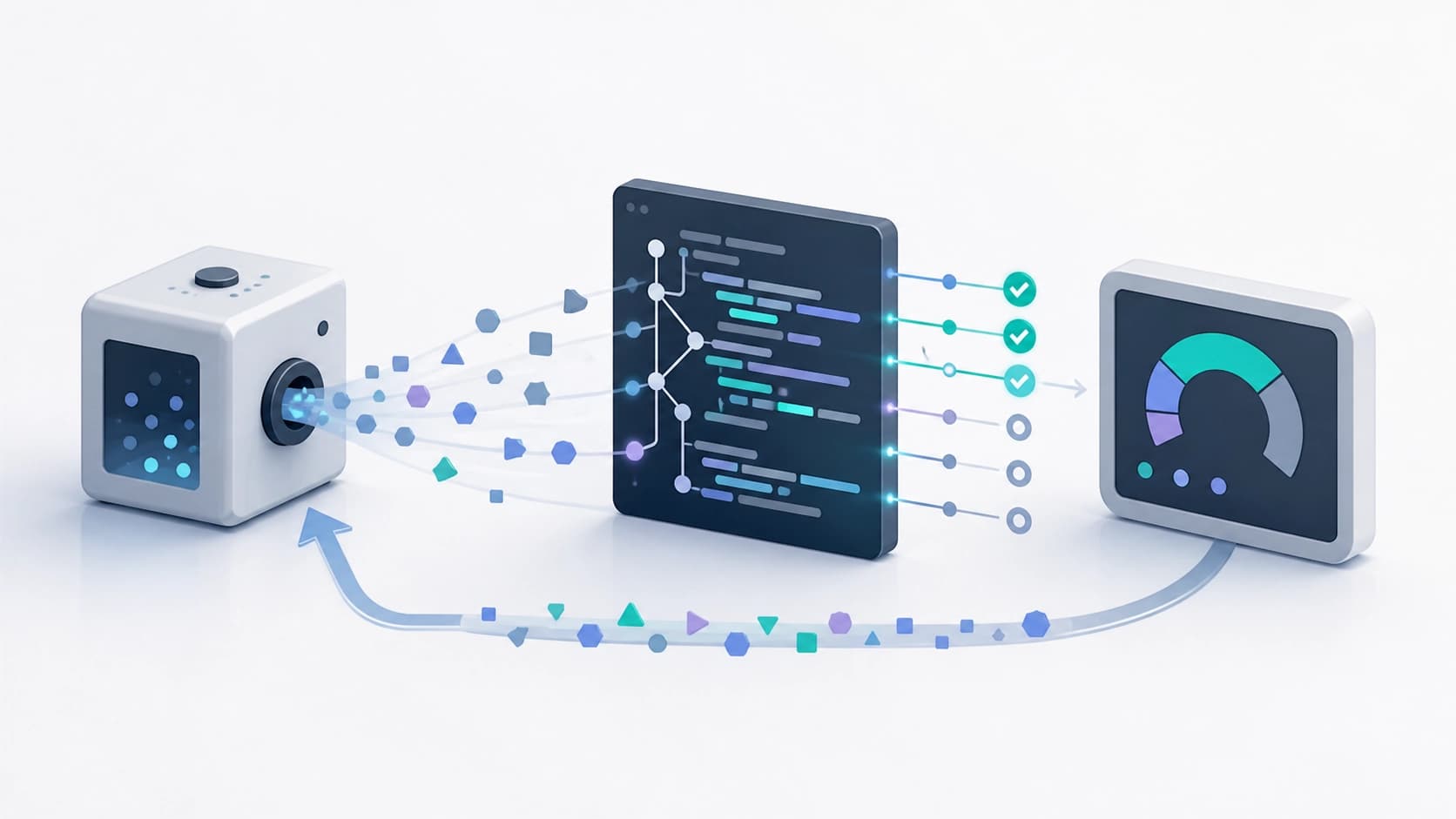
The secret of fuzzing is that each program run is measured not only by whether it crashes, but also by code coverage. This dense signal makes partial progress visible: even if a vulnerability is not found, a new execution path is already a step forward. The fuzzer uses coverage to mutate input data and to decide which branches to spend resources on. It does not rank completed runs, but actively directs the search into unexplored areas.
In science, a similar mechanism could work in exactly the same way. Every experiment, even one that fails in terms of the final hypothesis, is valuable if it expands the epistemic map—knowledge about which parts of the theory space have already been tested and which remain blank spots.
Two Conditions for a Working Research Agent
For an auto-researcher to truly search rather than sample, it needs two related capabilities.
- A cheap dense signal. Each experiment must, before final scientific validation becomes available, provide an observable indicator of epistemic progress. This is not necessarily a precise metric of truth, but rather an indicator of novelty, uncertainty, or deviation from the current model of the world.
- Feedback must drive action. The received signal must influence the choice of the next intervention. If the agent merely logs progress but continues sampling in the same area, there is little benefit. The progress signal must mutate the "input data" of the research, just as a fuzzer mutates test cases.
Importantly, the dense signal is precisely a direction, not a final verdict. Therefore, final validation still remains necessary: it evaluates claims using evidence protected from adaptive reuse. Otherwise, an agent that adjusts to the signal thousands of times might accidentally produce a false discovery that passes verification only due to overfitting.
Experiment: Search vs. Sampling
The authors tested these ideas in a simulated physical environment. An AI agent had to discover a hidden physical law. One agent was designed to track its own intermediate epistemic progress—something like "coverage of the space of possible explanations." Other agents used classical optimization of the final result.
The result showed that the agent tracking progress successfully found the hidden law. Baseline optimization approaches failed: they repeatedly sampled already available data and overfit to it, never daring to test unpopular regimes. This confirms that the central bottleneck of autonomous research lies not in the ability to generate hypotheses, not in model capacity, and not even in data volume, but in the architecture of feedback.

What This Changes
Comparing scientific auto-researchers to fuzzers is not just a metaphor, but an engineering principle. If we want AI to make real discoveries, we cannot give it only a sparse goal and wait. We need to design dense signals that make even slow progress visible, and then allow the agent to use those signals for exploration.
This approach changes the attitude toward failure in science: not only a successful experiment is valuable, but any step that narrows the space of the unknown. In a sense, this brings us back to how human science works in practice: scientists move from one partial result to another, and only sometimes do these paths add up to a major breakthrough that could not have been planned in advance. Autonomous research systems, it seems, will have to learn the same—not to plan discoveries, but to create the conditions under which they become possible.
Frequently asked questions
Related materials
All materials
Canonical Polynomial Invariants for Diagnosing RL Simulator Failures: Where Are They Actually Useful?
The study examines whether incorporating physical laws into learnable dynamics models is justified: invariants extracted from trajectories and reduced to canonical form using Gröbner bases yield modest forecasting gains, but prove powerful for diagnostics, enabling the localization of violated constraints and identification of specific erroneous parameters.
10 November 2026
AURA-Eval: How to Check Whether an LLM Agent Recognized a Risk and Changed Its Next Step
The framework evaluates LLM agents’ behavior not by their final verdict, but by how they respond to risk at key decision points: tool-call trajectories are interrupted, after which the model must continue reasoning and acting, while a panel of LLM judges assesses risk detection, the nature of the step, and its safety. Across 1,249 tasks drawn from 157 R-Judge trajectories, unsafe actions become more frequent among 20 models when no safe path is available, and removing oversight before execution turns 52.3% of initially safe cases into unsafe ones.
10 November 2026
Chern–Simons Reservoir Memory: Autonomous Connectivity Dynamics and Density Transport
The article explores how a reservoir preserves the history of input signals both in its density distribution and in its geometric degrees of freedom. A comparison of four mechanisms shows that current creates a separate connected component that alters the subsequent density response, while accounting for all measured features yields a small improvement in decoding pulse order.
10 November 2026