

In a recent arXiv preprint (2608.17542), submitted on August 18, 2026, Jack Boylan and Chris Hokamp propose an unconventional approach to combating collapse in JEPA world models. Instead of imposing a predefined shape on the latent space, they extract a signal against degeneration from the transition data itself. The method is called AC-MTM — Action-Contrastive Masked Transition Modeling — and, judging by the experiments, it works particularly convincingly in complex visual environments.
Why JEPA Models Collapse
The JEPA (Joint Embedding Predictive Architecture) approach is built around predicting future embeddings rather than pixels. This is convenient, but such an objective function has a trivial solution: the encoder can lock onto a constant and produce the same representation for any input. The prediction error then drops to zero, and no learning of world relationships occurs. This is why all practical JEPA implementations add additional anti-collapse mechanisms — from regularizers to architectural constraints.
One common technique is regularization of the latent distribution. For example, the LeWorldModel (LeWM) uses SIGReg, a regularizer that forces representations to look like isotropic Gaussian noise. This stabilizes training, but at the cost of a rigid assumption: the latent space must conform to a specific distribution unrelated to environment dynamics. The authors of the new paper argue that the pressure preventing collapse can come not from outside, but from the transitions between states themselves.

Contrastive Inverse Dynamics Instead of Gaussian Constraints
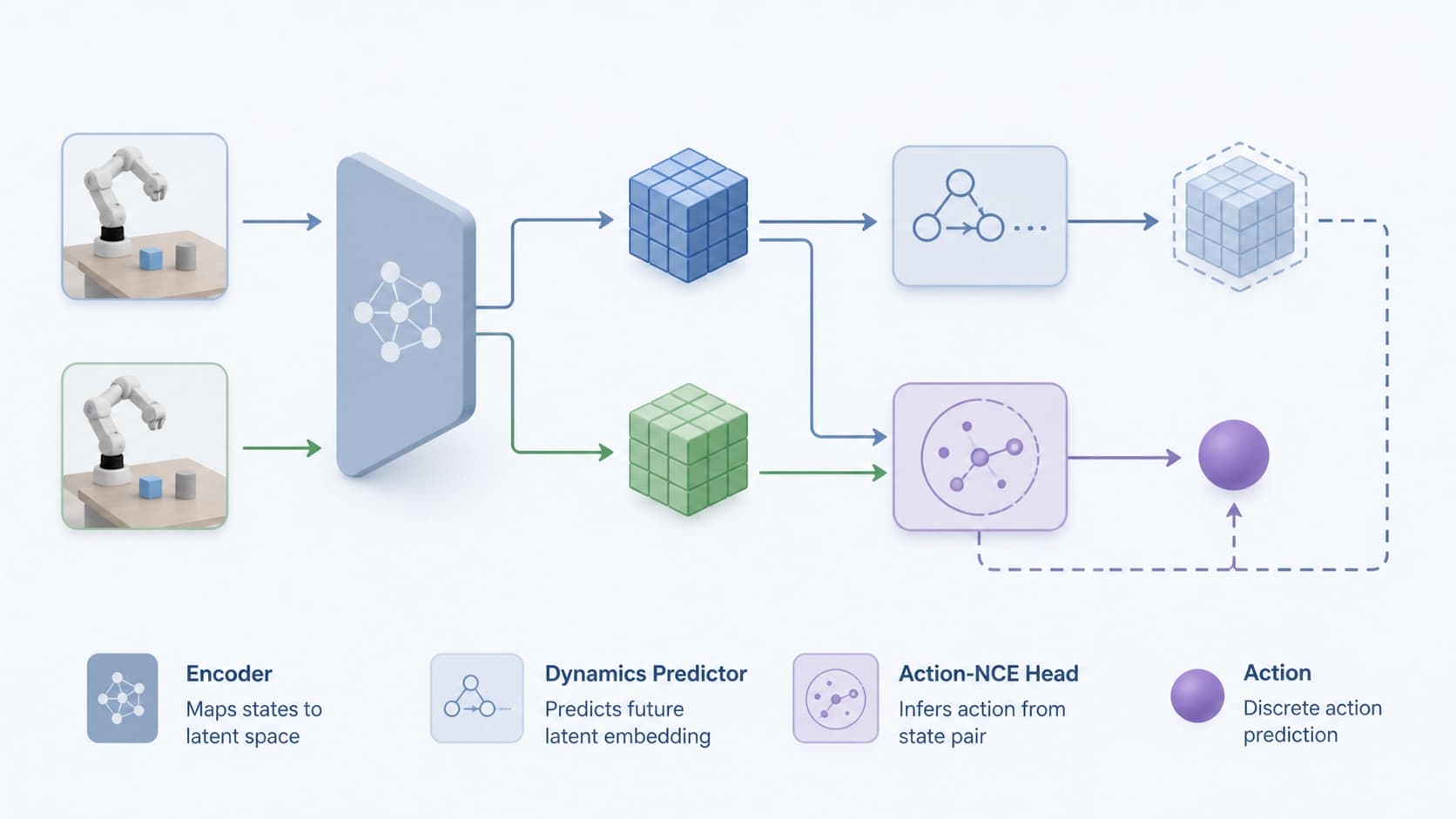
AC-MTM retains the direct latent prediction objective, as in LeWM, but adds an auxiliary inverse dynamics head. This head exists only during training and solves a discriminative task: given a pair of latent states, it must determine which specific action transitioned the model from the first to the second. The Action-NCE loss forces each latent transition to identify the action that generated it among all actions in the batch.
This formulation requires neither a target network, nor stop-gradient, nor a pretrained encoder, nor reconstruction. The key point is that a collapsed encoder, which produces identical representations for all states, is physically incapable of distinguishing one action from another. This makes the inverse dynamics task unsolvable, providing a provable signal against degeneration. The pressure arises from the data structure, not from an artificial prescription.
After training is complete, the inverse dynamics branch is simply discarded. At test time, encoding, forward prediction, planning, and computational costs remain identical to LeWM — no additional inference overhead.
What the Experiments Showed
The method was evaluated on four standard pixel-control tasks with a consistent planning protocol. AC-MTM trains stably from scratch and on average shows results comparable to SIGReg. In other words, abandoning the Gaussian regularizer does not lead to a loss of quality in simple environments.
The picture is more interesting on the complex OGBench Visual Scene benchmark. There, AC-MTM achieves 80.0±2.0% success, while SIGReg reaches only 58.0±2.0%. The improvement is 20–24 percentage points on each training seed. To put this in perspective: a single run of a random policy over 50 episodes yields a baseline of 52%, so the difference between the methods is truly significant.
At the same time, contrastive inverse dynamics does not rely on distributional assumptions. The authors characterize the assumptions about the action space and observability under which the method works, but these conditions are noticeably milder than the Gaussian requirement.
Practical Implications
The main takeaway of the paper: to avoid collapse, you don't need to decide in advance what representations should look like. It's enough to set a task that a degenerate encoder is guaranteed to fail. This approach turns out to be not only more principled but also delivers better results on complex visual tasks where SIGReg's Gaussian constraints hinder learning.
The code is publicly available, so the results are easy to reproduce and adapt to your own projects. For anyone building world models on JEPA ideas, AC-MTM is a practical option: no additional inference costs, no target networks or stop-gradient, and a more natural source of training signal.