

WordAI
Neural network service for automatic rewriting (paraphrasing) of texts while preserving the meaning and structure.
Overview
WordAI
Description of the WordAI neural network
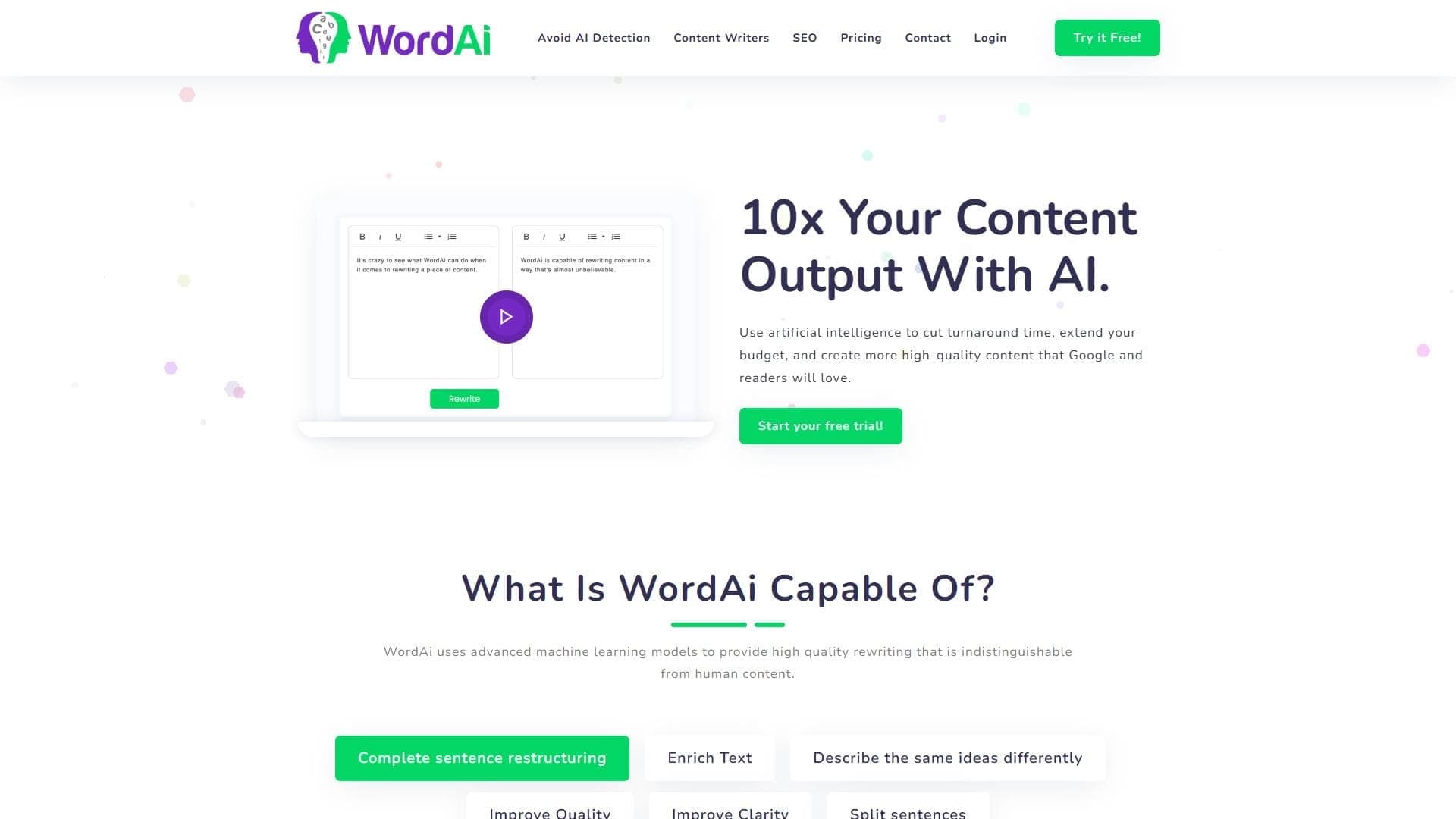
WordAI is a specialized service based on neural networks designed for automatic rewriting (paraphrasing) of texts. The service processes the source material so that it retains its original meaning and structure while becoming unique and readable.
The underlying technology relies on machine learning algorithms that produce high-quality paraphrases quickly. WordAI pays particular attention to the needs of those working in search engine optimization: the service can automatically insert LSI keywords into the text, increasing its relevance to search engines.
WordAI is geared toward working with large volumes of content. Results can be obtained within minutes using the web interface, API, or batch file processing, making the service a convenient solution for mass production of unique texts.
WordAI characteristics
| Characteristic | Value |
|---|---|
| Type | Neural network for automatic text rewriting |
| Categories | Rewriting, SEO tools, Text humanization, Copywriting, Neural networks with API |
| Website | wordai.com |
| Distribution model | Paid |
| Target audience | SEO specialists, copywriters, marketers |
| Work formats | Web interface, API, batch processing |
Who is the WordAI neural network suitable for?
SEO specialists
WordAI is primarily in demand among those who are involved in website search optimization. The service helps quickly obtain unique versions of texts without losing meaning, and the automatic addition of LSI keywords simplifies content optimization for queries.
Copywriters and content managers
For text authors, the service helps speed up routine rewriting tasks. Instead of manual rewriting, one can delegate the initial reworking to the neural network and then refine the result to fit their needs.
Marketers
For specialists who manage content across multiple platforms, WordAI is convenient for creating different unique versions of the same article. This saves time and resources on preparing a large amount of material.
How to use the WordAI neural network?
Uploading text
The user starts by uploading the source material. Text can be entered through the service's web interface at wordai.com, after registering.
Choosing paraphrase parameters
Before launching processing, you need to set the paraphrase parameters. The settings allow you to control how strongly the text will be changed, as well as to enable LSI keyword insertion to improve relevance.
Getting the result
After processing starts, the finished result appears within a few minutes. The completed text can be copied directly or used for further stages of work.
Main functions of WordAI
Automatic text rewriting
The main function of the service is automatic rewriting, in which the meaning and structure of the source material are preserved while the wording becomes unique. This makes it possible to use the same material for different purposes without the risk of duplication.
LSI keyword insertion
WordAI can automatically add LSI keywords — words and phrases related in meaning to the main topic — to the text. This increases the material's relevance for search engines and has a positive effect on SEO metrics.
Working with large volumes of data
The service is designed to process large text arrays. The ability to use the API and batch processing allows WordAI to be integrated into existing workflows and to automate content production on a large scale.
Benefits of WordAI
Fast processing of large volumes
One of the main advantages is speed. Even significant amounts of text are processed in minutes, which is critical under tight deadlines and a constant flow of tasks.
High-quality paraphrasing
Through the use of machine learning, the service delivers high-quality paraphrases without losing the original meaning. The resulting texts remain readable and suitable for further use.
Improved SEO metrics
Automatic keyword insertion helps increase content relevance, which has a positive effect on search engine rankings.
Easy API integration
The API makes it possible to embed WordAI into existing workflows and automate text preparation without manual intervention.
Disadvantages of WordAI
It takes time to learn
The service has a learning curve: you need time to understand the interface and configure all features for your tasks. Beginners may find it difficult to get the desired result right away.
High cost for small businesses
The subscription model may be expensive for small companies and freelancers with limited budgets. This limits the service's accessibility for some potential users.
Text-only operation
WordAI is solely focused on text materials. The service does not support other formats, which narrows its scope and makes it impossible to process, for example, multimedia content.
What tasks does WordAI solve?
Automatic rewriting for SEO promotion
The service helps quickly produce unique texts that do not lose their meaning. This is useful when preparing content intended for search engine promotion.
Creating unique versions of articles for different platforms
WordAI makes it possible to prepare different versions of the same article for publication on multiple websites. This solves the problem of content duplication across different resources.
Reducing time and costs for writing texts
Automating paraphrasing significantly saves time and reduces the cost of preparing new content. Instead of writing material from scratch, existing content can be quickly reworked.
WordAI pricing
The service is distributed under a paid subscription model. The source data notes that the subscription may be expensive for small businesses; however, detailed information about specific plans and their prices is not provided on the source page. For this reason, exact prices are not given here — for up-to-date pricing information, you should refer directly to the service's official website.
Terms of use for WordAI
To work with the service, registration on the website wordai.com is required. After creating an account, the user gets access to the web interface and the service's functions. In addition, using WordAI involves a paid subscription, since the service's distribution model is paid.
Availability of WordAI
The tool is available through the official website wordai.com. Users can work with the service through a browser-based web interface, and can use the API or batch processing to automate processes. No separate applications or versions other than the web platform are mentioned in the source data.
How WordAI differs from alternatives
Focus on SEO and automation
WordAI is specifically focused on the needs of SEO promotion and automated text rewriting. It is not a general-purpose universal neural network, but solves a narrow yet important task of preparing unique content.
Working with volumes and LSI keywords
A distinctive feature of the service is its ability to process large volumes of text via the API and batch uploading, as well as automatically add LSI keywords. These capabilities define its positioning for professional users who work with large-scale content.
Exclusively text-focused specialization
Unlike broader services, WordAI works only with text materials and does not support other formats. At the same time, its price, according to sources, may be higher than some alternative solutions, which is worth considering when choosing a tool, for example, for small businesses.
Conclusion
WordAI is a highly specialized neural network for automatic text rewriting, aimed primarily at SEO specialists, copywriters, and marketers. The service stands out for its high processing speed even for large volumes of content, its ability to preserve meaning during paraphrasing, its automatic LSI keyword insertion, and its convenient API integration. At the same time, it has limitations: it works only with text, requires time to learn, and has a relatively high subscription cost, making it less accessible to small businesses. Overall, WordAI is a practical tool for those who regularly produce large amounts of unique content for search engine promotion.
Frequently asked questions
See also


A service for detecting texts created by artificial intelligence, with the ability to check for plagiarism and grammar.
Free five-day intensive from Kaggle and Google on building AI agents using the vibe coding technique.
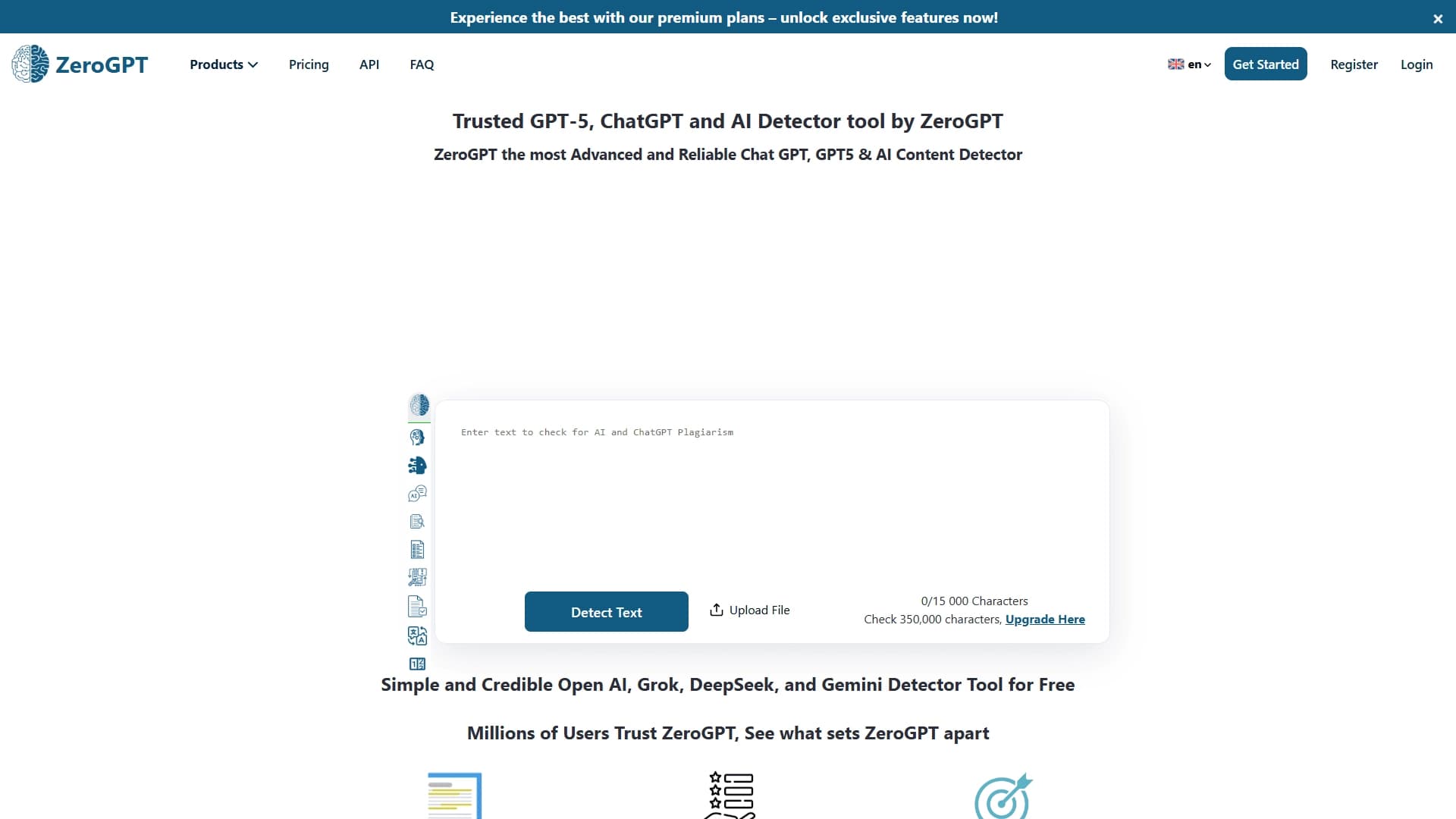

An online detector that determines whether text was created by a human or generated by neural networks.


AI-based platform for generating text content: articles, advertisements, social media posts, and product descriptions.


AI assistant for checking grammar, spelling, and style of English text, available as a browser extension and web editor.
AI editor for creating, editing, and publishing content with templates and prompts.


AI-based tool for generating and optimizing text content.
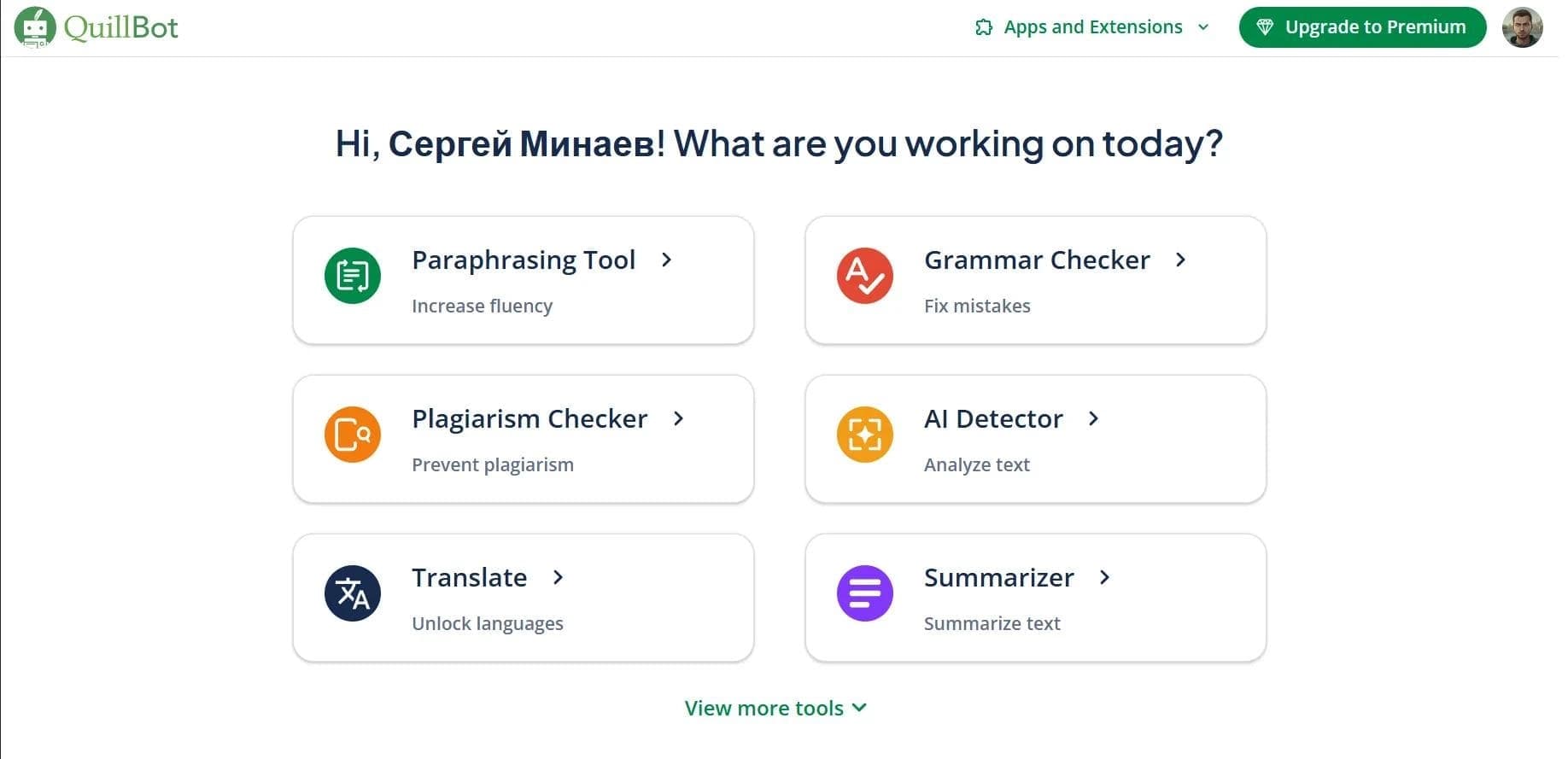

AI assistant for paraphrasing, grammar checking, and working with text in multiple languages.