

Book Wizard AI
AI tool for creating complete books from idea to finished PDF file.
Overview
Book Wizard AI
Description of the Book Wizard AI neural network
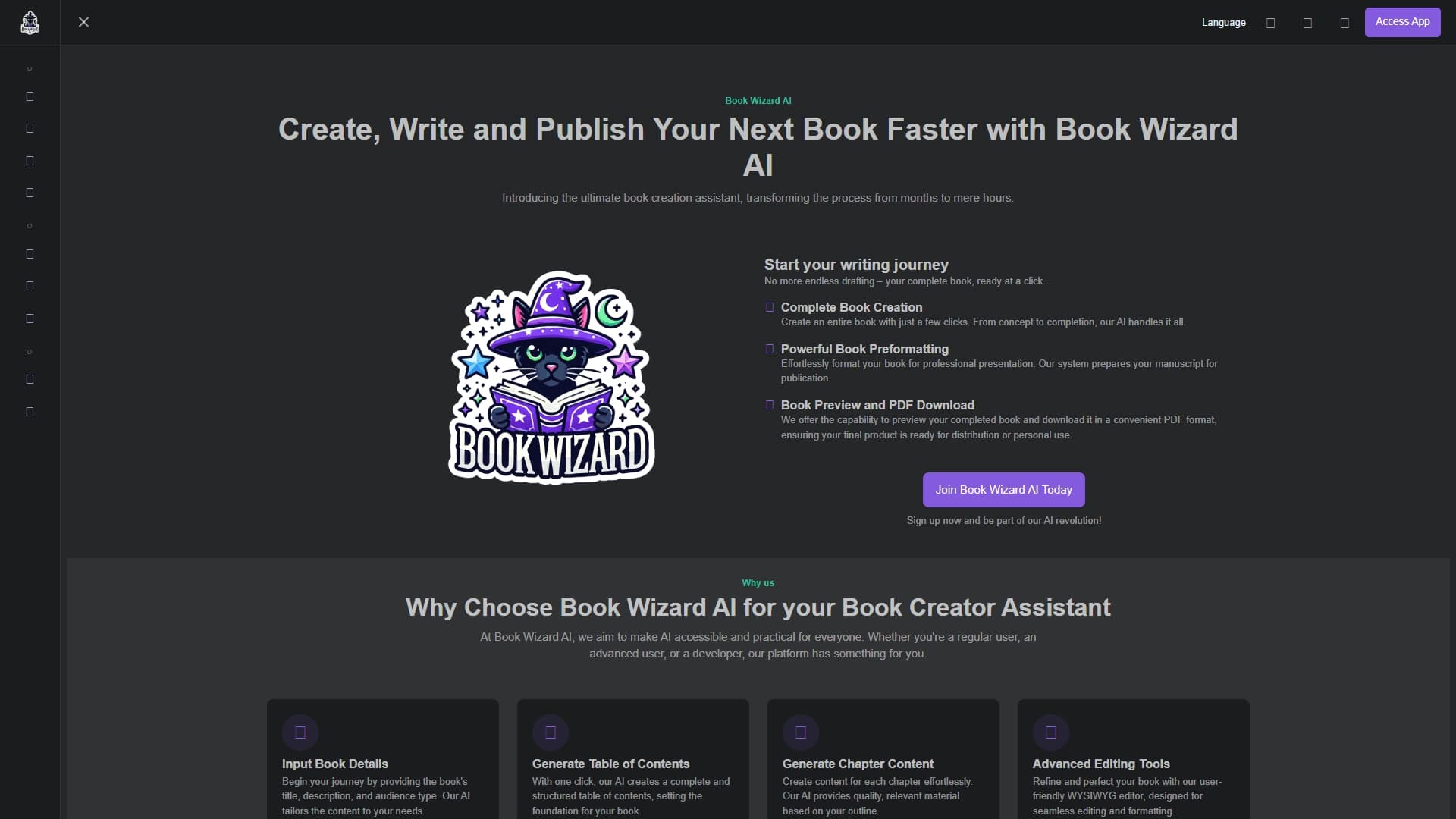
Book Wizard AI is a specialized tool based on artificial intelligence that automates the process of creating books. The neural network handles the entire workflow: from the initial idea and genre selection to generating structured text and exporting the finished file.
Unlike simple text generators, Book Wizard AI positions itself as a comprehensive assistant for authors. The service doesn't just create individual fragments — it builds a full-fledged manuscript with an outline, chapters, and preliminary formatting. The tool can be used for fiction novels, non-fiction literature, methodological guides, and educational materials.
The key goal of the service is to reduce the time from the moment an idea is conceived to getting a draft version of the book, ready for further refinement and publication.
Book Wizard AI characteristics
| Characteristic | Value |
|---|---|
| Tool type | AI assistant for book generation |
| Category | Novels, copywriting |
| Platform | Website (bookwizardai.com) |
| Export formats | PDF (differs) |
| Interface languages | Not specified |
| Available regions | Not specified |
| Primary purpose | Creating books from idea to finished file |
Who is the Book Wizard AI neural network suitable for?
Fiction writers and authors
Book Wizard AI will be useful for authors who want to speed up the process of writing novels and short stories. The tool helps quickly build the framework of a future work, avoiding the long "blank page" period.
Non-fiction authors and creators of methodological materials
The service is suitable for creating business literature, guides, methodological manuals, and training courses. The structured approach allows breaking complex material into logical chapters and sections.
Copywriters and content creators
The tool can be used to generate large text materials: corporate books, book-format landing pages, author newsletters, and other content that requires serious development.
Authors striving for productivity
The main target audience is those who want to cut months of routine work down to a few hours and get structured, readable text without having to build the structure from scratch.
How to use the Book Wizard AI neural network?
Step 1: Setting book parameters
At the start, the user formulates the topic of the future book, determines the genre, the key ideas to convey, and the desired text volume. The more accurate and detailed the input data, the better the result will be.
Step 2: Automatic outline building
Based on the entered parameters, the neural network forms the book structure: it breaks the material into parts, chapters, and sections. This allows you to see the logic of the future narrative in advance and adjust it if necessary.
Step 3: Generating chapter text
After the outline is approved, the AI sequentially fills chapters with text content. The user doesn't need to control every stage — generation happens automatically.
Step 4: Review and export
The finished material is available for preview. Already at this stage the text has a structure: headings, paragraphs, and a chapter breakdown. All that remains is to export the manuscript to a PDF file and, if necessary, do the final editing.
Main functions of Book Wizard AI
Full-cycle book generation
The tool guides the author through all stages: from formulating the idea to getting a finished manuscript file. This eliminates the need to use several different services.
Automatic outline and chapter text creation
Book Wizard AI develops the book structure and fills it with text without user involvement. The author only needs to set the initial parameters and wait for the result.
Preliminary formatting
Each generated book is automatically formatted: chapters have headings, and text is divided into logical paragraphs. This process precedes export and simplifies the final preparation of the manuscript.
Preview and export
The user can evaluate the finished material in preview mode before exporting it to PDF. This allows detecting obvious structural or content errors at an early stage.
Advantages of Book Wizard AI
Significant time savings
The tool speeds up the entire book workflow. What would take months manually can be created in a few hours of working with the service.
Quick idea testing
Thanks to the generation speed, the author can quickly test literary and marketing hypotheses, release more books, and respond faster to audience demands.
Reduced manual editing volume
The structural approach and automatic formatting reduce the amount of work needed before publication. The text comes out organized, with a clear division into chapters.
Versatility of use
The service handles both fiction texts and documentary literature equally well, making it useful for a wide range of authors.
Disadvantages of Book Wizard AI
Limited export formats
Unlike some competitors, Book Wizard AI offers export mainly to PDF. This may be inconvenient for authors who need other formats (e.g., EPUB, DOCX) for e-books or print shops.
Insufficient data transparency
The official website lacks detailed information about the number of generated pages, supported languages, regional availability, and the nuances of pricing plans, which makes it difficult to evaluate the service in advance.
Dependence on input data quality
The result directly depends on how thoroughly and accurately the author formulates the topic, genre, and key ideas. A too vague assignment will lead to a weak or template manuscript.
What tasks does Book Wizard AI solve
Creating a book from scratch
The tool allows getting a complete manuscript on a given topic and genre without manually working out the structure. The user only needs to set the parameters — the neural network will do the rest automatically.
Preparing a manuscript for publication
Automatic formatting, chapter breakdown, and headings reduce the time between finishing the text and preparing it for publication.
Speeding up the writing process
For those who write a lot and regularly, Book Wizard AI becomes a scaling tool — the same idea can be quickly adapted to different formats or audiences.
Structuring complex material
When working with methodological guides or educational texts, the neural network takes on the ordering of information, arranging it into chapters and sections in a logical sequence.
Book Wizard AI prices
The official website bookwizardai.com does not have public information about subscription costs or individual pricing plans. Current prices at the time of writing are unknown.
To obtain cost information, it is recommended to go to the service website, register, and review the available pricing options, or write to support.
Terms of use of Book Wizard AI
Information about the service's terms of use (license agreement, copyright for generated texts, commercial use of books) is not publicly available on the source website. Users planning commercial publication of books should carefully review the user agreement before starting work to make sure the tool is permissible for their purposes.
Book Wizard AI availability
Book Wizard AI works as a web application and is available on the official website bookwizardai.com. Using the service requires internet access and an up-to-date browser.
Information about interface languages and the countries where the service is officially available is not specified in the sources. Before planning long-term work with the tool, it is worth clarifying these aspects on the website.
How Book Wizard AI differs from analogues
The main difference between Book Wizard AI and many other text neural networks is the full cycle of book creation. Most tools generate only separate text blocks or chapters, while Book Wizard AI automatically builds the entire book structure and brings the work to PDF format.
An additional difference is the focus on preliminary formatting. The service immediately produces a manuscript with headings and paragraph breakdown, bringing it closer to the final publishing look.
Among the closest analogues, AIeBookGen stands out; however, a detailed comparison of functionality and result quality requires a separate study of both services.
Conclusion
Book Wizard AI is a useful tool for authors for whom it is important to reduce the time spent on creating a structured manuscript. The neural network automates routine stages, allowing you to quickly move from an idea to a finished PDF file. The tool is suitable for both fiction texts and methodological and educational materials. The lack of pricing details and the limited export format may be a restraining factor, but for those who are ready to work within the stated framework, the service will become a reliable assistant in literary work.