

Adola
Service for connecting a voice AI assistant to phone lines and automating calls.
Overview
Adola Neural Network Description
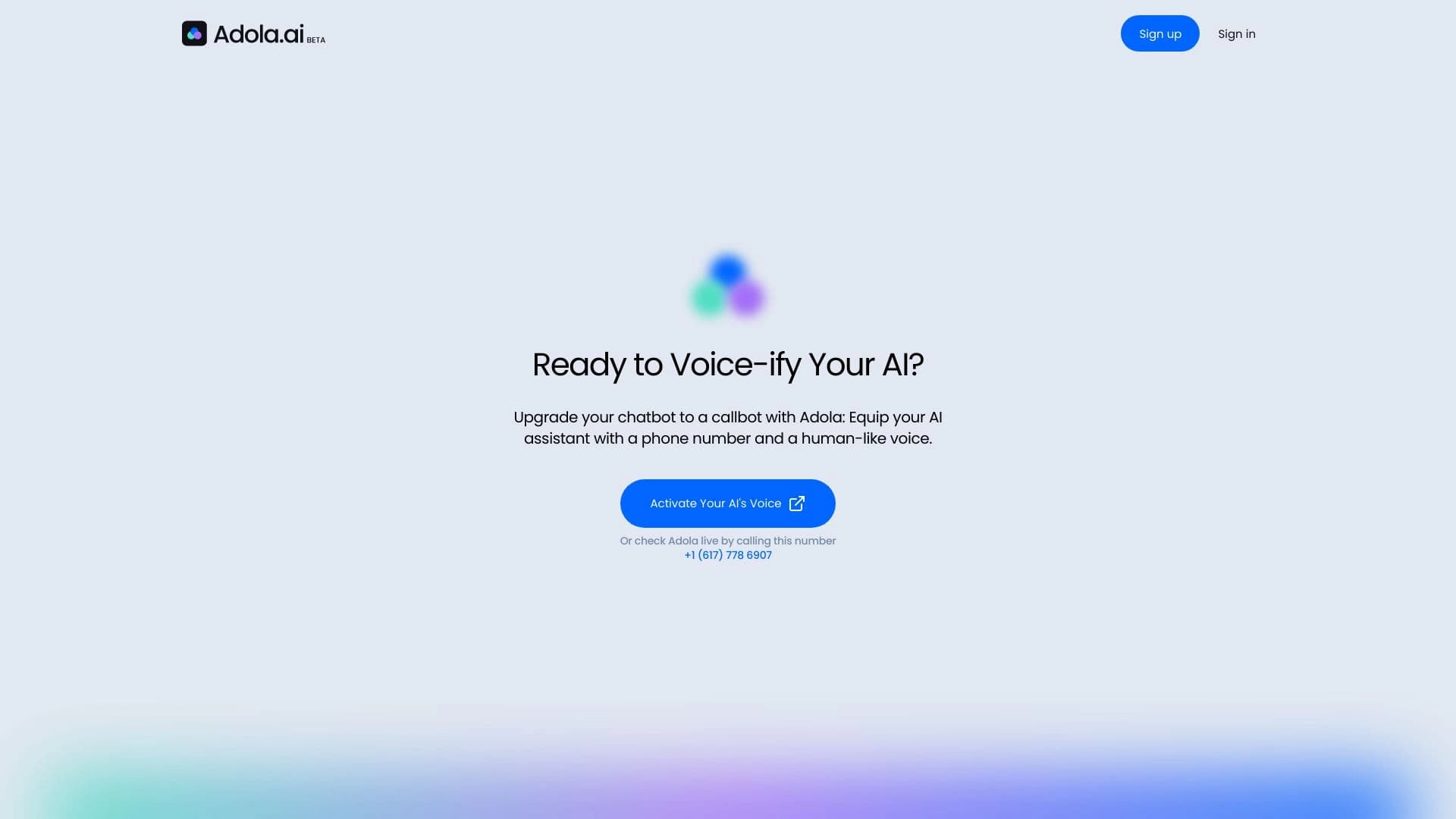
Adola is a platform that turns an ordinary phone into a smart voice channel for business. It allows you to connect an AI voice assistant powered by the OpenAI API to an existing phone line. Essentially, it's a bridge between your business and modern language models: the service provides a real phone number, configures a "character" for the assistant, and the bot begins to independently answer or make calls, communicating with customers in a natural, lifelike voice.
Adola's key feature is speed and ease of deployment. The service is designed so that even a non-IT specialist can set up a voice operator in a couple of minutes. Instead of spending time configuring complex infrastructure, you get an intuitive interface where you just choose a number, set parameters, and connect the API. The assistant can work during peak hours and after hours without getting tired or distracted, and can easily scale to match the volume of calls and the company's needs.
Adola Features
| Feature | Value |
|---|---|
| Type | Tool for voice assistants and speech synthesis |
| Categories | Voice assistants, speech synthesis, chatbot creation, advertising |
| Developer | Adola AI GmbH |
| Platforms | Website (adola.ai) |
| Monthly visits | 38.6K |
| Free plan | Yes (Starter, limited functionality) |
| Basic subscription | 2,290 RUB per month |
| Professional plan | 4,990 RUB per month |
| Interface languages | Not specified (multiple assistant languages supported) |
| Access from Russia | Only with VPN (according to one source) |
| Editorial rating | 9.4 out of 10 |
| User rating | 4.7 out of 5 |
Who is Adola neural network for?
Small and medium-sized businesses in the service industry
Adola is an ideal tool for restaurants, dental clinics, barbershops, auto repair shops, medical clinics, legal, and service companies. These industries constantly need to handle incoming calls, book clients, and answer common questions. The assistant takes over the routine, allowing administrators to focus on live interactions with visitors and not miss calls even during the busiest hours.
Call centers and companies with high call volumes
For organizations where the phone is the primary communication channel, Adola becomes an indispensable assistant. It can handle multiple simultaneous inquiries, reducing the load on operators. The tool is suitable for both inbound and outbound calls, automating call campaigns and data collection.
Developers and integrators
Adola offers deep customization capabilities. Developers can use the service's API to integrate with CRM and internal systems, creating solutions tailored to specific business processes. Flexible assistant behavior configuration allows it to be embedded into existing IT infrastructure without major changes.
How to use the Adola neural network?
Setup and configuration
The launch process takes just a couple of minutes and requires no special technical knowledge. You need to go to adola.ai, register, and choose a phone number for the assistant. Then you connect the OpenAI API, which will serve as the "brain" of your voice operator.
Choosing a "character"
After connecting the API, you can choose a voice and configure the assistant's "character." You can set the tone of communication, speech style, and behavioral traits. If you already have a text chatbot, you can use it as a base and add a phone number to it in the same couple of minutes, turning it into a full-fledged voice assistant. The service allows you to quickly switch between different voices to find the one that best suits your brand.
Key Adola Features
Answering and making calls
The assistant independently handles incoming calls and can make outgoing calls. It's a full-fledged replacement for a first-level operator, capable of working in real time.
Handling common requests
The bot answers standard customer questions: business hours, address, service costs, and available slots. It can book appointments, make reservations, or transfer complex inquiries to a live employee.
Analytics and integrations
The service collects call analytics, allowing you to track the assistant's performance. Integration with CRM and other internal systems is supported for flexible business process automation.
Language support and scalability
Adola supports multiple languages, making it suitable for companies with international clients. Resources are easily scalable: you can increase the number of numbers and call volumes as your business grows.
Adola Advantages
Fast deployment
An AI phone number is issued within minutes, without long waits or complex bureaucracy. Integration with the regular telephone network goes smoothly and doesn't require deep technical knowledge from employees.
Natural voice
The assistant's voice sounds close to human. The caller often can't tell they're talking to AI, which increases customer trust and makes communication comfortable.
Reduced staff workload
Using Adola helps avoid missed calls and reduces the number of dropped calls. The assistant relieves administrators during peak hours and fully handles inquiries after hours, improving service quality without expanding the team and increasing customer loyalty.
Adola Disadvantages
Voice limitations
Despite the overall naturalness, the assistant's voice can sometimes sound unnatural and "robotic," especially when handling emotional or unusual situations. The bot may struggle with unexpected questions, give strange answers, or get confused.
Cost at high volumes
The plan includes a fixed number of minutes. If call volume is high, the cost of usage becomes significant — additional minutes require extra payment. For small companies, this could be a substantial expense.
VPN requirement for Russia
According to one source, access to the service from Russia is only possible using a VPN connection, which may create additional inconvenience.
What tasks does Adola solve?
Automating phone communication
Adola's primary task is to automate customer communication over the phone. The service turns a text chatbot into a full-fledged voice assistant capable of answering and making calls, saving company resources.
Handling inbound inquiries
The platform effectively handles incoming calls. The assistant books clients, makes reservations, and answers common requests, passing important inquiries to staff. This ensures uninterrupted customer support without fatigue or breaks.
Improving service convenience
Adola makes communication more lively and convenient compared to text interfaces. It provides round-the-clock operation, improves inquiry handling quality, and helps companies create a more human and caring image, which positively impacts the customer experience.
Adola Pricing
Starter plan
This plan is free and offers limited functionality. It allows you to explore the platform's capabilities and determine if it suits your needs.
Adola subscription for 2,290 RUB per month
The basic subscription unlocks access to the service's core features. The price includes a fixed number of call minutes, which may be enough for a small volume of inquiries.
Professional plan for 4,990 RUB per month
This plan is designed for more active use and offers expanded capabilities and priority support. It includes a larger number of minutes and additional tools. Exceeding the included minute limit may require additional payment.
Adola Terms of Use
Registration and API
To get started, you need to register on adola.ai. Connecting your own OpenAI API is a mandatory requirement — it serves as the intellectual foundation of the voice assistant.
Pricing system and limits
All paid plans have a fixed monthly cost that includes a certain number of call minutes. Exceeding the limit incurs additional charges. This should be considered when budgeting for automation. Detailed terms and plan descriptions are best checked on the official website.
Adola Availability
Platform and access
Adola is available as a web application, allowing you to use it from any device with a browser. Primary access is through the service's official website.
Geographic usage
The service supports multiple languages, making it suitable for businesses with an international clientele. However, according to some sources, access to Adola from Russia may require a VPN connection. There is no official information about other regional restrictions.
How Adola differs from alternatives
Focus on simplicity and speed
Adola's main difference from many competitors (e.g., Leadtex, Aimylogic, Botmother, and SaleBot) is deployment speed. While other platforms often require time to configure complex scenarios and integrations, Adola provides a working number and a configurable assistant within minutes. This makes the service ideal for those who need results "here and now."
Deep OpenAI integration
Unlike platforms with their own dialog builders, Adola uses the OpenAI API as its core. This provides flexibility and conversational naturalness that goes beyond rigidly scripted scenarios. The bot can answer a wide range of questions, not just those pre-programmed in advance.
Focus on telephony integration
Many of Adola's competitors (e.g., Botpress or ChatGPT) focus on text chats or web widgets. Adola, however, is natively designed for telephony, offering a ready-made voice communication solution with built-in call analytics. It's worth noting that Adola is positioned as an international product.
Conclusion
Adola is a practical, quickly deployable solution for businesses looking to automate phone communications with voice AI. It addresses the key need — turning a text chatbot into a live voice operator. Natural voice, easy phone line integration, and simple setup make the service attractive to companies that value their time and want to reduce staff workload. However, potential users should consider possible access issues in some regions, imperfect behavior in unusual situations, and a pricing structure that may become significant with intensive use.
Pricing
Frequently asked questions
See also

A multifunctional AI assistant for chat, text and image generation, translation, and programming help.
Multifunctional AI platform for content creation, combining speech synthesis, text generation, avatar creation, and video editing.
Intelligent assistant from Microsoft, built into the Bing search engine and Edge browser, powered by GPT-4.
AI keyboard for Apple devices that speeds up typing with corrections, translation, and response generation.
Automatically extract financial data from PDF documents and convert it to Excel or CSV.

Neural network for generating images and short videos from text descriptions.

Platform for creating multi-agent AI systems and chatbots to automate customer support and lead generation.

Web platform for communication and role-playing with AI characters.